
Funds held in a contract or transferred in error: what can realistically be done
Published: Last reviewed: Editorial standards
No party can reverse a confirmed blockchain transaction. As a rule, assets sent to an incorrect address or held by a defective contract return only where a person or entity with control chooses to act. That party may be a protocol team holding an admin function, an exchange that operates the receiving address, or the wallet owner. We identify the available options, contact the correct party and keep a written record of the case.
Any question on your case may be put to us here:
Who this service is meant for
- Tokens were sent to an incorrect address, an incorrect network, or to the token contract itself
- Assets are held in a contract that no longer permits withdrawal
- A bug or exploit in a protocol affected your deposit and the team has provided little response
- You operate a small project and users lost funds due to a fault in your contract
- You want a candid assessment of whether recovery is possible before spending more
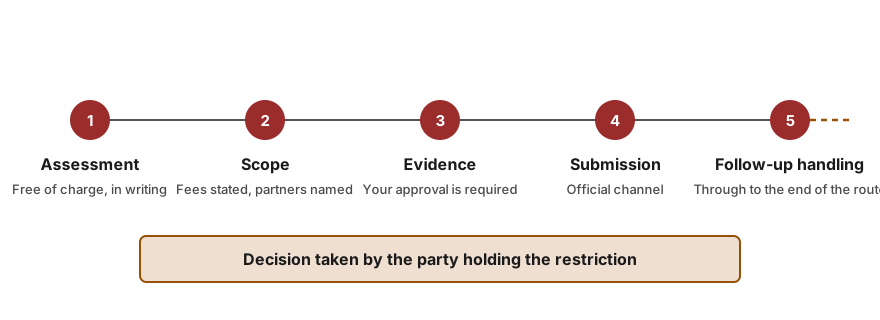
The procedure for a case
- Free initial assessment
You must provide the transaction hashes, the network used, and a description of the expected transfer outcome. We will then respond in writing regarding any potential recovery routes or if the funds are permanently lost.
- Scope and fee in writing
Before any payment is required, we outline the scope of work, the specialists involved, and the applicable fee model. If resolution is not feasible, the file closes at that time without cost to you.
- Blockchain and smart contract examination
The transfer is mapped first, after which independent specialists examine the contract code and its permissions. You receive a plain summary setting out who is able to act and who is not.
- Contact and written claim
A written approach is submitted to the party with authority to act, and every response is recorded. You receive copies of each submission we send and of each reply that comes back.
- Note on the outcome
The case closes with a brief written record of the steps attempted and the result obtained. Where no route remains open, we state this plainly and do not leave the file active.
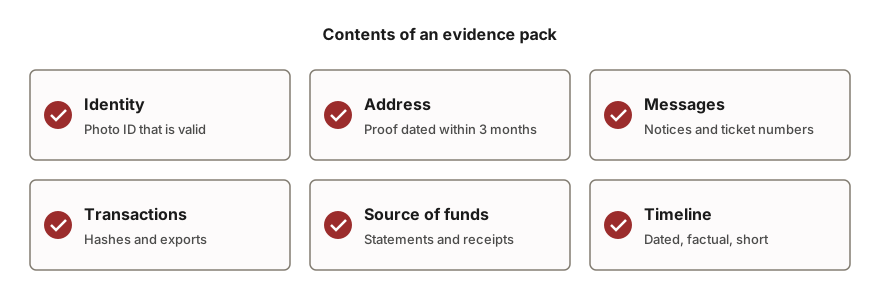
What to prepare
- For each transfer concerned, the transaction hash plus the name of the network it ran on
- The address of the sending wallet and the receiving address or contract address
- Screenshots of the app, the website or the exchange screen on which the problem appeared
- The name of the token, the address of its contract, and the official site or documentation
- Any correspondence with support teams, project channels or the receiving party
- Evidence that the sending account is yours, for example an exchange statement, but never a seed phrase or key
- A brief written timeline setting out what you intended and what actually occurred
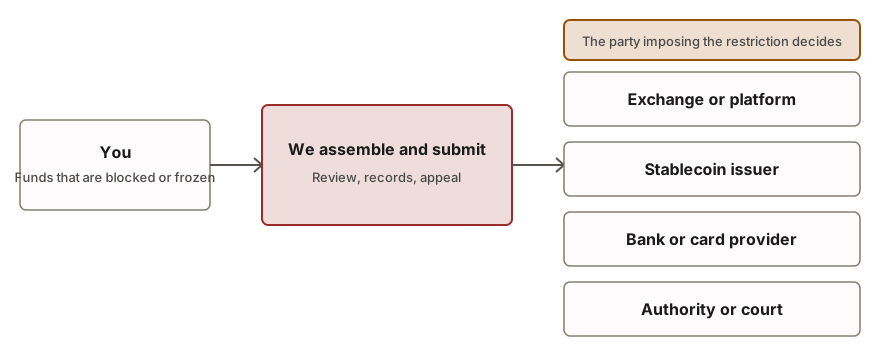
What our work involves
- Record what happened on-chain
We go through the transaction on a block explorer together: sender, receiver, network, token, contract and status. As a rule, some matters that appear lost prove to be pending, on another chain, or held at an exchange address.
- Identify whether any party can control the destination address
Determining if the receiving address operates as a private wallet, an exchange deposit entry, or a smart contract is required to identify the actionable party.
- Have the contract examined by independent specialists
Smart contract engineers examine the specific permissions within the code, including admin keys, upgrade proxies, and time locks. They will notify you in writing regarding potential routes for the return of funds and the responsible party.
- Send a written notice to the correct party
A factual communication is prepared for the protocol team, the exchange support team, or the address owner. This submission includes necessary hashes, addresses, and a clear request via official channels only.
- Coordinate claims and possible legal routes
If the opposing party is identifiable and the monetary value merits consideration, a licensed lawyer may advise on filing a claim or demand letter. If a compensation plan is part of the protocol terms, we assist you in filing the claim supported by proof of ownership.
What falls outside our role
- Once a transfer is confirmed on-chain, it is final. No one, including us, can reverse, cancel or edit that transaction.
- In most matters, a protocol team, an exchange or the receiving party must agree to assist. We cannot compel them, and they decide whether they will act.
- We do not promise a return of your funds. In many cases the honest answer is that recovery is not possible, and we say so in writing before you spend more.
- We do not exploit bugs, attack contracts or remove funds from contracts you do not own. Such conduct is unlawful in many jurisdictions and would damage your case.
- Our work relies solely on public data, so a seed phrase, a private key or a password is never requested from you.
Expected timeframes
Checking the chain is fast once you provide the transaction hashes. What follows rests with the other party: a protocol team, an exchange or an address owner may respond within days or months, or never. We notify you as responses come in.
Fees
The assessment costs nothing and shows whether any procedural route exists. Should we proceed, the scope and the fee model are provided in writing before any payment, and the contract review by independent specialists is quoted separately, so you may halt at any stage. Fees →
Frequently raised questions
Is it possible to recover crypto after sending it to the wrong address?
A return happens only when whoever holds that address agrees to send the funds back. Once a transfer is confirmed, the network offers no reversal procedure. If an exchange controls the address, its support desk may assist. Where the address is a private wallet with an unidentified owner, as a rule no route exists.
I sent tokens over the wrong network. Are they gone for good?
Not in every case. Where that address also exists on the other network and sits under the control of an exchange or wallet provider, recovery may be possible, in some cases for a charge. If no party controls that address on that network, the funds are in practice usually lost permanently.
What happens if I transferred tokens to the contract address of the token itself?
Retrieval in these situations is very difficult. Numerous token contracts contain no function that releases tokens sent in error, so the balance remains held there. Certain projects include a rescue function or can act by way of governance, so reviewing the code and contacting the team can be worthwhile.
Can a developer repair a bug so that my funds come back?
Occasionally. Where a contract is upgradeable or contains a pause or rescue function, the team holding those keys may be able to act, and some protocols operate compensation programmes after an exploit. A contract that cannot be modified cannot be fixed by any party.
Could you hack the contract so my funds are released?
No. Exploiting a contract is unlawful in many jurisdictions and can produce fresh losses. Any party offering to do so is, in practice, likely a scammer. Only lawful routes are used: reading the code, contacting the correct party and, where useful, obtaining advice from an independent lawyer.
Do you require my seed phrase in order to review my wallet?
The service operates exclusively through publicly available data, such as transaction hashes and wallet addresses. A legitimate specialist requires neither your seed phrase nor your private key to conduct this review. Should any individual request such sensitive credentials, you must discontinue communication and proceed with the assumption that the communication constitutes a fraudulent attempt.
Common situations
- Tokens transferred on one chain to an address that also exists on a different network
- Coins delivered to the contract address of a token rather than to a wallet address
- A staking or vesting arrangement that fails to release tokens once an upgrade or pause has occurred
- An exploit on a protocol emptied a pool that contained your deposit
- A mistyped or lookalike address, where the recipient turns out to be a genuine wallet held by another person
- A transaction that failed yet still charged the fee, leaving you uncertain where the assets sit
- A deposit sent to an exchange deposit address that does not list the token you transferred among its supported assets
Related situations
- The Response Procedure for DeFi Exploits and Bridge Hacks. Documentation, tracing and report filing once a DeFi exploit, bridge hack or bad approval has hit your funds.
- Report on blockchain transaction analysis. A source-of-funds report based on transaction tracing, prepared in a form a compliance team can review.
- Tracing stolen crypto and freeze requests. Tracing of stolen crypto, with freeze requests to exchanges and issuers and a police filing.
Read next
Sources
Authoritative and official pages on which this page relies. Such pages are updated, so confirm the current wording at the source itself.
- Introduction to smart contracts · ethereum.org
- Upgrading smart contracts · ethereum.org
The content on this page is general in nature and is not legal advice.