
Flagged as sanctioned or high risk in error: the procedure for contesting a false positive
Published: Last reviewed: Editorial standards
Screening software can flag your name, address or a counterparty against a sanctions list or risk category in error. This is called a false positive, and it occurs often where names are shared or exposure is only indirect. To clear the flag, evidence must show you are not the listed person or party, and as a rule that submission is made through a lawyer. Our role is preparing that evidence and coordinating independent licensed lawyers. Where the match is genuine, we cannot assist you in avoiding it.
Any question on your case may be put to us here:
Who this service is meant for
- Your name resembles that of a listed person and your account has been frozen
- An exchange or bank states that a counterparty or address you transacted with is sanctioned or high risk
- Funds passed through a service later placed on a list, and you received them without knowledge
- A screening tool assigned your wallet a risk label that appears incorrect to you
- You were informed your account was closed for compliance reasons, with no further explanation given
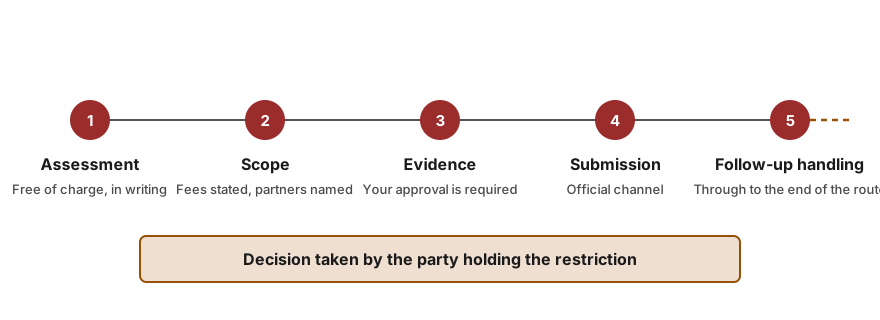
The procedure for a case
- Free initial assessment
After receiving the notices and a description of the flag, we will inform you in writing regarding its potential status as a false positive. We will also define the assistance that may be possible and identify necessary evidence.
- Scope and fee in writing
Should the service proceed, you will receive the defined scope of work, our fee structure, and the terms of the independent lawyer exclusively in writing before any payment is required.
- Gather the evidence
Documentation must be provided to the service through a secure channel. We review these submissions for deficiencies or any records that conflict with the stated entry before the information is coordinated for the lawyer.
- Submission by the lawyer
Once your record is complete, the independent lawyer drafts the statement or request and files it through the channel the authority prescribes. You are sent copies together with the reference numbers.
- Follow-up handling
Our role after filing is coordination: we monitor responses, help you answer any follow-up questions, and give you a plain account if the match proves genuine or if the procedure offers no further route.
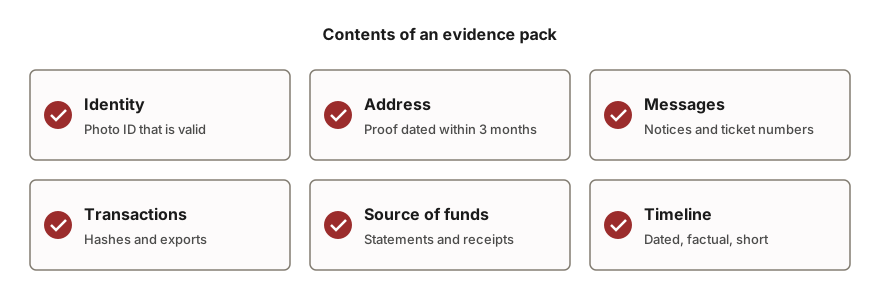
What to prepare
- Passport or national identification document showing your full name, date and place of birth
- Evidence of your address and, where a company is concerned, registration records together with the ownership structure
- The notice issued by the provider that names the flag, including the dates and reference numbers it contains
- Transaction records covering every wallet or account that appears in the matter
- Documents showing how the funds that were flagged came into your possession
- Any screening result or clearance document you already hold from an earlier procedure
- A brief submission in writing setting out why you are not the person or party listed
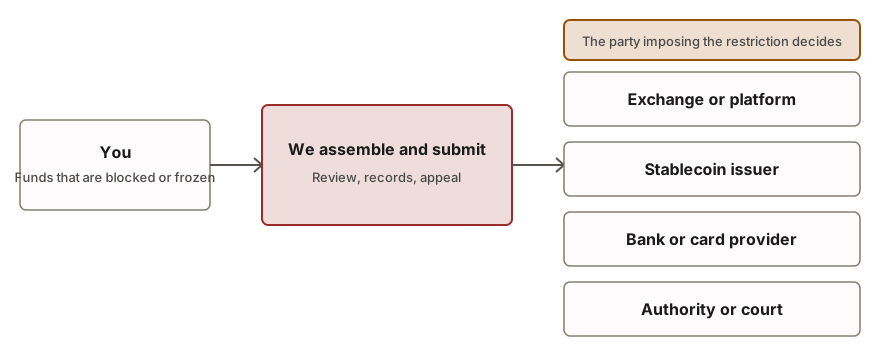
What our work involves
- Determine the precise matched item
We establish whether the restriction pertains to you, a specific address, a counterparty, or a transaction path. Since the appropriate response varies, we record the matched item and the classification utilized by the issuer.
- Distinguish a false positive from a genuine match
Next we set your identity data against the listed entry: name variants, dates, places, identifiers and roles. If the evidence indicates a real match, we say so plainly, and at that point our work stops.
- Assemble the evidence pack
The process requires gathering identity documents, residency proof, corporate records, the asset history, and documentation demonstrating no connection to the listed party. This compilation ensures the materials are organized for use by independent counsel.
- Instruct independent licensed lawyers
Licensed independent lawyers are responsible for executing all legal submissions. The service prepares the factual basis and exhibits, agreeing upon the scope of work with both you and the attorney.
- Assist the follow-up with the provider
The service assists you in answering additional questions from the compliance team and maintains a detailed record of the ticket. Should a regulatory or listing authority possess a review pathway, the independent lawyer decides whether to pursue it.
What falls outside our role
- We do not assist with evading sanctions that are genuine. Should the match be real, we tell you plainly and end our involvement.
- No one on our side can compel a provider, regulator or listing authority to clear a flag. That decision rests with them, and certain reviews proceed slowly.
- Only independent lawyers may handle legal submissions. We prepare the necessary evidence and coordinate the formal procedure, but we do not provide legal counsel.
- Your seed phrase, private keys and passwords are never requested by us.
Expected timeframes
Resolution of a false positive by the provider may require several days or weeks. A formal review by an external authority can extend into months. We furnish an estimated timeline following the initial assessment and update the projection as the case progresses.
Fees
The initial assessment provided by CryptoAppeals remains free of charge to you. Following this, you will receive a written scope and fee model, encompassing the independent lawyer's charges, prior to your commitment. No fee is requested until we determine our capacity to assist. Fees →
Frequently raised questions
What constitutes a sanctions false positive?
This occurs when screening software erroneously flags your assets. The software compares identifying information, such as addresses and wallets, against regulatory lists. Although the data may appear similar, it is not identical, which can mistakenly identify an innocent party. While a human reviewer is required for clearance, this process does not always proceed in a timely manner.
How do you distinguish between a true match and a false positive?
Compare your personal identification data against the specifics of the listed entry. This includes the full name, date of birth, locations, and associated identifiers or roles. If these parameters differ, it indicates a probable false positive. Should they align, you must treat it as a confirmed match and halt all activity involving the funds pending legal advice.
Will CryptoAppeals provide assistance if the match appears to be genuine?
CryptoAppeals does not assist with activities intended to evade or bypass authentic sanctions. If the initial assessment concludes the flag is accurate, we record this finding in writing and formally close the case. Adhering to this advice early on protects you from potentially worsening your situation.
Why does this process require a lawyer?
A submission asking an authority or an exchange to remove a flag, or to challenge a listing, carries legal consequences. In practice, such a request should come from an independent licensed lawyer. Our role is limited to preparing the record and coordinating the exchange of documents, so counsel receives a complete and orderly file.
Can a wallet of mine end up flagged even though I acted lawfully?
Yes, that can happen. A wallet may receive funds that, several transactions earlier, passed through a listed service. Analytics tools such as Chainalysis may treat that exposure as a risk score. Exposure is not proof of wrongdoing, yet as a rule you will be expected to document where the funds originated.
While the matter is open, should I transfer the funds to a different account?
You should not. As a rule, moving flagged funds can appear to be an attempt to conceal them, and this may complicate the case. Keep activity on the flagged account stopped, retain every message in writing, and await the advice of the lawyer.
Common situations
- A common name resembling a listed person, with a matching birth date or country
- Residential or registered company address near a listed party, or in a sensitive jurisdiction
- An incoming transfer traced several hops to a service later placed on a sanctions list
- A business partner or customer matching a list entry that describes another company
- A wallet flagged by analytics tools with no clear explanation of the exposure
- An account held while the compliance team awaits legal review of the match
Related situations
- Disputing risk flags from wallet screening. High-risk address flag from screening tools: record the funds path and dispute it.
- Source of funds and wealth documentation packs. Build a clear source of funds and source of wealth pack for exchanges, banks and processors.
- Unblocking an exchange account. Understand the restriction, prepare KYC and AML evidence, reply and appeal.
- When authorities freeze your cryptocurrency. When authorities hold your assets, we arrange independent licensed lawyers. This is not legal advice.
Read next
Sources
Authoritative and official pages on which this page relies. Such pages are updated, so confirm the current wording at the source itself.
- Does Coinbase freeze accounts? · Coinbase
The content on this page is general in nature and is not legal advice.