
After a crypto scam: the procedure to follow during the first 72 hours
Published: Last reviewed: Editorial standards
Five actions belong in the first 72 hours, in this order. Stop all further payments, then secure your accounts and wallets. Preserve every item of evidence. Report to the exchange, to the stablecoin issuer where one is involved and to the police. Finally, ignore anyone who offers recovery unprompted. Speed helps, since platforms can act only while funds remain traceable, but no result can be promised.
Any question on your case may be put to us here:
Hours 0 to 2: halt further payments
No further payment should reach the scammer, even when you are told that one last fee will release your funds. That demand is a usual second stage of the same scam. Send nothing more, and do not borrow money to pay.
The next task is to protect what remains. Should you have disclosed a seed phrase, an access code or screen access, treat the wallet as exposed. A new wallet, set up on a clean device, should receive the remaining assets, and the passwords for e-mail, exchange and telephone accounts should be replaced.
- Close any remote access tool, and remove every app that the scammer told you to install.
- Turn on two factor authentication through an authenticator app, not by SMS, for your e-mail and exchange accounts.
- Where it is safe to do so, revoke the token approvals of the affected wallet.
- If fiat payments were involved, telephone your bank and ask whether a recall is possible.
Hours 2 to 12: preserve the evidence
Evidence vanishes quickly, because scam websites go offline and chat accounts are deleted. Capture it before taking any other step in the matter.
Do not erase conversations out of anger. Take screenshots that show the dates, and keep the original messages. While your memory is fresh, write the sequence of events down as a timeline.
- Each transfer, with its hash, wallet addresses, amount and date.
- Captures of the site, the app, every chat, all e-mails and the profiles involved.
- Web addresses, names, usernames and telephone numbers that the scammer used.
- Bank or card records covering the payments that financed the transfers.
- A written timeline stating who approached you, what was promised and what you sent.
Hours 12 to 36: file reports with the proper bodies
Reports should be made side by side, not in sequence. Each one yields a reference number, and those numbers are needed at later stages.
Where your funds passed through an exchange, write to its fraud or compliance team and attach the hashes and the timeline. Where the stolen asset is a stablecoin from a central issuer, that issuer may act on a valid request. Such platforms can freeze funds that are still in place, but each takes its own decision.
- The exchange you sent from and, if it is visible to you, the exchange that received the funds.
- The police, or the national cybercrime unit of your country, with a list of the evidence.
- Bank or card issuer, in respect of any payment made in fiat currency.
- The platform on which the scammer approached you, for example a social network or dating app.
Hours 36 to 60: map the destination of the funds
The blockchain records where stolen funds went. Enter the receiving address in a block explorer and note the next step the funds took. Should they have arrived at an exchange deposit address, inform that exchange and the police.
An independent specialist can convert the trail into a formal analysis that police and platforms are able to use. That analysis does not return the funds. Its function is to support a request.
Hours 60 to 72: guard against recovery scammers
Victims are approached again within days. Messages come through social media, e-mail and telephone from people who present themselves as investigators, hackers or lawyers able to retrieve funds for a fee.
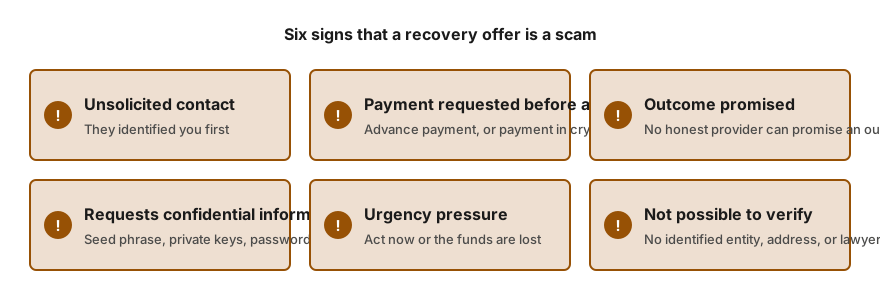
Leave unsolicited offers unanswered. A genuine provider does not need your seed phrase, does not require payment before saying whether it can help, and does not promise results. A separate guide on this site lists the warning signs in full.
The period after the three days
Maintain a case file holding every report number and every reply. Progress is usually slow: police and platforms may need weeks to respond, and many cases end without a return of funds.
Where the sum is significant, a free assessment may be requested from us. We say candidly whether the evidence supports any route, then prepare the package and coordinate independent lawyers and analysts. Recovering funds directly is beyond us, and no seed phrase, private key or password is ever requested.
Frequently asked questions
Does the passage of 72 hours mean the opportunity has gone?
No. Speed is an advantage because funds may still be held by a platform able to act, yet the later steps are identical: preserve evidence, report and request an assessment. Some routes narrow as time passes, so begin now.
May I challenge the scammer directly and ask for repayment?
No. Contact alerts the scammer, who may delete evidence and may ask for more money. Stop replying, keep everything you hold, and direct your effort to reporting and to securing your accounts.
Will the police be able to recover my crypto?
Police may investigate, and in some cases an authority can seize funds. Results differ widely between countries and cases, and recovery is uncommon. A report should still be filed, since its reference number assists with banks and platforms.
Is an exchange able to reverse a blockchain transfer?
No, because nobody can reverse such a transfer. An exchange can occasionally freeze funds that remain on its platform, provided it receives a valid report in time, but it has no duty to do so.
A person claims to be able to hack the scammer's wallet. Is that genuine?
Regard it as a scam. Hacking another person's wallet is a crime, and no honest provider offers it. The speaker is most probably a second scammer seeking an advance fee or your seed phrase.
How we can help
- Tracing stolen crypto and freeze requests. Tracing of stolen crypto, with freeze requests to exchanges and issuers and a police filing.
- Report on blockchain transaction analysis. A source-of-funds report based on transaction tracing, prepared in a form a compliance team can review.
- The Response Procedure for DeFi Exploits and Bridge Hacks. Documentation, tracing and report filing once a DeFi exploit, bridge hack or bad approval has hit your funds.
- Appealing a stablecoin issuer freeze. A documented appeal, prepared for Tether, Circle or another issuer of stablecoins.
The content on this page is general in nature and is not legal advice.