
How blockchain tracing functions: what it can establish and what it cannot
Published: Last reviewed: Editorial standards
Blockchain tracing follows transfers across a public ledger, address by address. Analysts group addresses that appear likely to share one owner, attach labels to known services, and search for the stage at which funds arrive at an exchange or another service that holds customer identity records. A trace can establish where funds moved. It cannot, standing alone, establish who a person is or recover the money.
Any question on your case may be put to us here:
A public ledger that records movement, not names
Most major blockchains keep a record of every transfer in a public ledger. Any person can see that one address sent a stated amount to a second address at a stated time. Creating an address requires nobody to supply a name.
The ledger is therefore open, but pseudonymous. The money can be followed in fine detail, yet the record itself does not state who controls each address. Tracing is the procedure of narrowing that gap, to the extent the evidence permits.
The procedure analysts use to follow funds
The basic step concerns following outputs. An analyst begins at a known address, examines where the funds moved next, and then where they moved after that. Software renders these hops as a graph, which allows a long chain to be read at a glance.
Analyst tools also capture timing, amounts and patterns of movement. A rapid run of transfers in split amounts, for instance, may point to an attempt to obscure the trail. The analyst records such patterns but does not treat them as proof.
- Trace each transfer from the origin address onward through the addresses that receive it.
- Log amounts, timestamps and the networks involved, cross chain bridges included.
- Record familiar entities like exchanges, payment handlers and smart contracts.
- Document where the trail stops or turns uncertain, and state the reason.
Address clustering and labels
Clustering is a procedure that collects addresses likely controlled by one owner. The groupings rest on heuristics, for example several addresses appearing as inputs in a single signed transaction, or repeated reuse of a change address. Such inferences are educated guesses, not certainties.
A label assigns a name to a group of addresses, for instance an exchange, a gambling site or a wallet known for fraud. Such labels are drawn from public material, from services the tracer knows directly and from reports submitted by others. A label may be inaccurate or no longer current. For that reason, a careful report always records its own degree of certainty.
Mixers, bridges and other obstacles
Mixers take deposits from many users at once and pay them out in fresh amounts, so the direct link between what went in and what came out is broken. Bridges and swaps carry value onto another network, and there the record has to be traced anew. Privacy oriented coins and repeated moves between chains introduce further steps.
Obstacles do not always terminate the ongoing investigation. Analysts may infer links utilizing transfer timing and monetary values. A result following a mixer remains a probability, not a definite fact, and must be reported accordingly.
Exchanges Function as Potential Exit Points
Regulated exchanges and specific services require the collection of identity documents from those who use them. Should funds that are disputed or stolen reach a deposit address at such a service, that entity retains critical information regarding the account controller. This is the basis for considering exit points important.
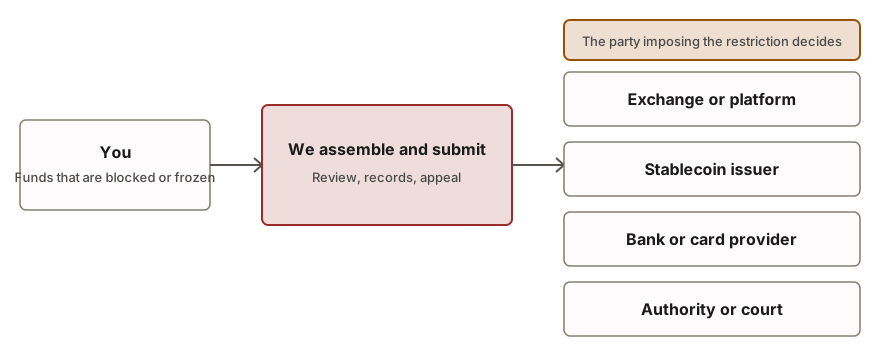
A trace may identify the relevant service provider. That service decides subsequent action following a court order, a police submission, or a proper request. The provider may decline, freeze the account, or demand evidence, as we cannot compel an exchange to perform such an action.
What a trace shows and what it leaves unclear
A comprehensive trace illustrates the fund route, the locations of transactions, and the elapsed time through various services. This information supports a submission to the authority, police, or the issuer of the assets.
This process cannot confirm an individual's identity, the motive behind a transfer, or the certainty of every link in the chain. Transfers are not reversible by tracing. If a formal case requires evidence, an independent analyst will prepare a report, and we assist with scoping the request for the correct party.
Frequently asked questions
Is it possible for any individual to trace my cryptocurrency transactions?
The public ledger permits anyone to observe transaction visibility on those particular chains. Attaching an address to a real person generally requires external information, like records held by an exchange. Casual reviewers only observe addresses and are not provided with personal names.
Will a trace procedure definitively reveal a scammer's identity?
A trace does not operate independently. Investigation may lead to an exchange or another provider that maintains account data. Law enforcement or a court must then petition that provider for the required information. The final outcome depends on the governing jurisdiction and the applicable terms of service.
Do mixers make funds impossible to trace?
The use of mixers complicates the tracing procedure and reduces the certainty of the findings. Analysts may determine connections using transfer timing and specific transaction amounts. These outcomes are probabilistic, and the resulting report must clearly articulate its reliability.
To what extent are the labels provided for specific addresses accurate?
Labels are useful but not infallible. Data for these labels originates from multiple disparate sources and may be incorrect or outdated. An analyst carefully verifies critical identifiers by comparing various sources and states the confidence level.
Will a tracing report recover my funds?
The report itself functions as evidence. It can support a request submitted to an exchange, an issuer, or law enforcement, but those entities alone decide the subsequent action. No one can make a promise that funds will be returned.
How we can help
- Report on blockchain transaction analysis. A source-of-funds report based on transaction tracing, prepared in a form a compliance team can review.
- Tracing stolen crypto and freeze requests. Tracing of stolen crypto, with freeze requests to exchanges and issuers and a police filing.
- The Response Procedure for DeFi Exploits and Bridge Hacks. Documentation, tracing and report filing once a DeFi exploit, bridge hack or bad approval has hit your funds.
- Disputing risk flags from wallet screening. High-risk address flag from screening tools: record the funds path and dispute it.
The content on this page is general in nature and is not legal advice.