
Wallet restricted on one or more networks: unblocking cases from USD 50,000
Published: Last reviewed: Editorial standards
Only the party that controls a restriction can lift it, whether that is a token issuer, a custodian, an exchange, a payment service or an authority. We have no power to unblock a wallet ourselves. Our part is to prepare the case, present it to the correct party and coordinate independent specialists and lawyers. That work is costly, so cases begin at USD 50,000. No outcome is guaranteed.
Any question on your case may be put to us here:
Minimum case size: USD 50,000. We handle wallet unblocking cases from this amount, since the specialist and legal work below this level is not economical.
Who this service is meant for
- Your wallet or address is blacklisted, frozen or flagged, and a large balance cannot be moved
- An issuer, custodian or service holds the restriction, and no technical fault is involved
- Funds are spread over several networks, and the restriction touches more than one
- A modest attempt through ordinary support failed, and the sum now warrants formal work
- A company needs a frozen treasury wallet or customer wallet examined
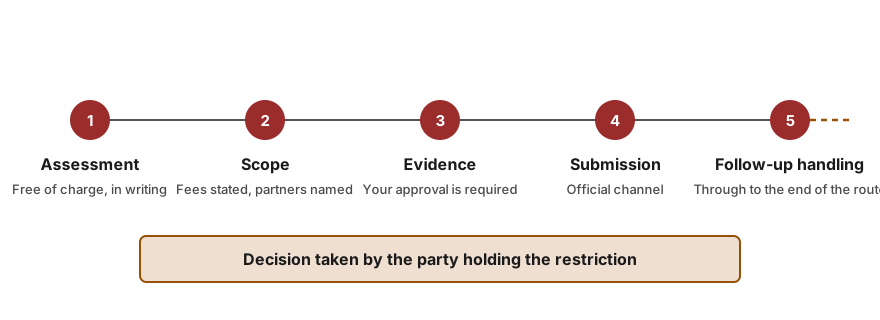
The procedure for a case
- No-charge assessment
You describe the wallet, the networks involved and what you know. In writing, we then say whether the case fits and whether it reaches the minimum size.
- Scope and fee, in writing
Before any payment, you are given the scope, the fee model and the names of the independent specialists and lawyers involved.
- Building the case
Specialists analyze the history on the chain. Documents come from you through a secure channel, and any gap is resolved before anything is dispatched.
- Presenting the case
The case goes to the issuer, custodian or service, or through counsel to the authority. Copies and all reference numbers are passed to you.
- Follow-up, then closure
We monitor replies, deal with further questions and state plainly when the available routes are exhausted.
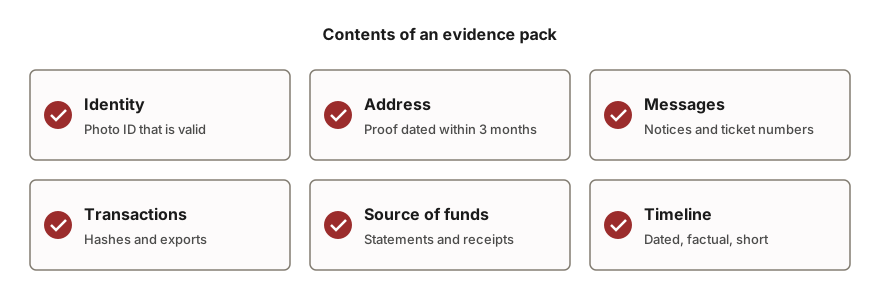
What to prepare
- Addresses of the frozen or flagged wallets, and the networks they use
- Hashes of the principal inbound and outbound transactions
- Evidence that you control the wallet, shown with no keys or seed phrase disclosed
- Government photo ID with proof of address, or company papers where a business is involved
- Records of how the funds were acquired, for example bank transfers, invoices and exchange exports
- Each notice, e-mail or ticket sent by the issuer, custodian, service or authority
- A written timeline of events
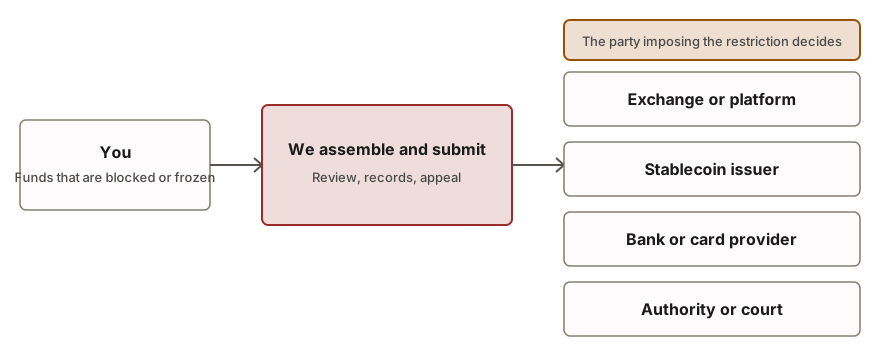
What our work involves
- Find out who truly holds the restriction
We follow the restriction back to its owner, be it an issuer, custodian, exchange, payment service or authority. Unblocking can come only from that party, so each later step depends on this being correct.
- Judge viability and fit with our case size
The amount, the facts and the probable ground are reviewed. You are told frankly if the route is weak, or if the case falls under the size at which specialist and legal costs are justified.
- Produce the evidence and the analysis
Independent specialists build the transaction history and a source-of-funds analysis. We merge their work with your records of identity, ownership and acquisition into a single consistent file.
- Put the case before the deciding party
A formal request or appeal is drafted and lodged through the proper channel, with exhibits attached. Independent licensed lawyers take over that portion where the restriction rests on legal process.
- Keep networks and parties aligned
When funds or flags cover several networks or services, we maintain one timeline and one set of documents. Every party then sees identical facts, and your account of events stays free of contradiction.
What falls outside our role
- A wallet cannot be unblocked by us. Whoever controls the restriction is the only party able to lift it, and that party decides.
- No issuer, custodian, service or authority can be compelled by us to act, and no result or timeline is promised.
- Cases begin at USD 50,000. Under that size, specialist and legal costs normally exceed what a case can reasonably recover, so we say so and do not collect a fee.
- We give no help in altering or backdating a document, and a case with no realistic route, in our judgment, is declined.
- Your seed phrase, private keys, passwords and remote access are never requested by us.
Expected timeframes
Timelines differ widely. A review by an issuer or custodian may last weeks, while anything involving legal process may last months. An estimate is given after the assessment and revised as work proceeds.
Fees
The assessment carries no charge. Cases begin at USD 50,000, since the work calls for paid analysts and frequently lawyers. Fees are quoted in writing after the assessment, and none is requested before we say whether we can assist. Fees →
Frequently raised questions
Which party is able to unblock a frozen wallet?
Only the party that imposed the restriction or controls it. With a stablecoin that is normally the issuer. With a hosted account it is the custodian or exchange, and with an authority hold it is the authority or a court. No outside party can override any of them.
What justifies a minimum case size of USD 50,000?
A serious case requires blockchain analysts, prepared documents and often a licensed lawyer, and those costs are real. Below this size they would absorb most of what might be recovered, so declining at the start is the more honest course.
Does the minimum amount work as a fee?
No. It marks the smallest balance we accept. The assessment is free, and the fee model is quoted in writing afterwards. You pay nothing until we have told you whether we can assist.
What if my balance is below USD 50,000?
Other pages here may suit you better, for instance exchange account unblocking or issuer appeals, and our guides let you do much of the groundwork yourself. If we cannot take your case, we say so clearly.
Is a private key needed from me to unblock a wallet?
No, never. Control can be proven without keys, for example by signing a message. Anyone who asks for a seed phrase or a key is not acting in your interest, and you should end the contact.
Can one wallet be unblocked on every network at once?
Generally not. A freeze usually attaches to one token on one network, so a wallet can be restricted on a single chain and unrestricted elsewhere. Each network is mapped separately, and we report which restrictions exist.
Common situations
- The issuer has frozen a stablecoin balance held at your address
- A custodian keeps a wallet restricted after a compliance review
- Screening tools flagged an address, and services now decline funds that came from it
- Funds bridged out of a frozen wallet on another network carry the same flag
- A business wallet was restricted when a counterparty was tied to a sanctioned or fraudulent address
- A hold followed a request from an authority, and the holder cannot obtain any information
Related situations
- Diagnosing who froze your crypto. Establish who froze your funds and which next step is realistic.
- Appealing a stablecoin issuer freeze. A documented appeal, prepared for Tether, Circle or another issuer of stablecoins.
- Report on blockchain transaction analysis. A source-of-funds report based on transaction tracing, prepared in a form a compliance team can review.
- When authorities freeze your cryptocurrency. When authorities hold your assets, we arrange independent licensed lawyers. This is not legal advice.
Read next
Sources
Authoritative and official pages on which this page relies. Such pages are updated, so confirm the current wording at the source itself.
The content on this page is general in nature and is not legal advice.