
Blockchain analytics report: trace where your funds came from for compliance
Published: Last reviewed: Editorial standards
A blockchain analytics report sets out how funds reached an address: which transfers occurred, through which counterparties, and with which risk flags. Independent specialists prepare it using public ledger data, and we convert that into a clear written document for a compliance team. It can show the path of the funds. It cannot establish who controlled an address, why a payment was made, or that a platform is obliged to accept it.
Any question on your case may be put to us here:
Who this service is meant for
- A compliance team has asked you to show the origin of your crypto, and the records you hold do not cover it fully
- Multiple transfers were used before your funds reached you, and a clear written record of that route is needed
- You want to understand why a platform flagged your deposit, and what its screening system likely detected
- A lawyer or an accountant requires a neutral written summary of the on-chain record
- You wish to review an address in writing before accepting a large transfer
The procedure for a case
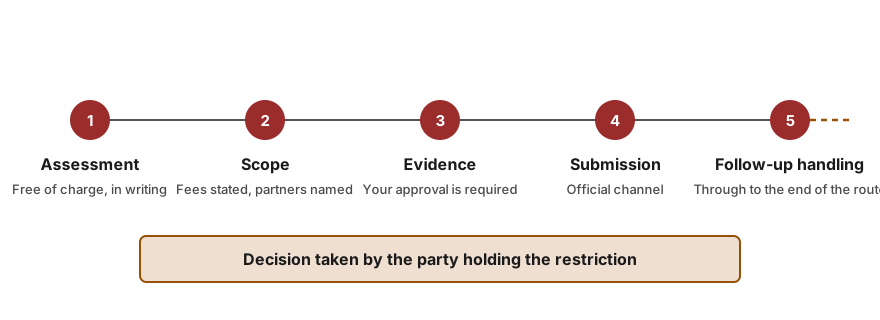
- Free initial assessment
You describe who requested what, and for what reason. We reply in writing on whether a report would be of use and what it would require.
- Scope and fee in writing
Before any payment is due, you receive the question, the addresses covered by the scope, the independent specialists assigned to the matter, and the fee model in writing.
- Transfer Tracing
The independent specialists trace the transactions and identify the counterparties. After they complete their draft, we examine it for missing links and for assertions that the data does not justify.
- Record Reconciliation
The on-chain history is checked against the documents you provide. Where the two do not agree, we raise each discrepancy with you before the report is completed.
- Handover and Use
When the report is finished, you receive it together with a brief guide on presenting it to the relevant parties. On request, we can assist you in submitting it to the platform or to counsel.
What to prepare
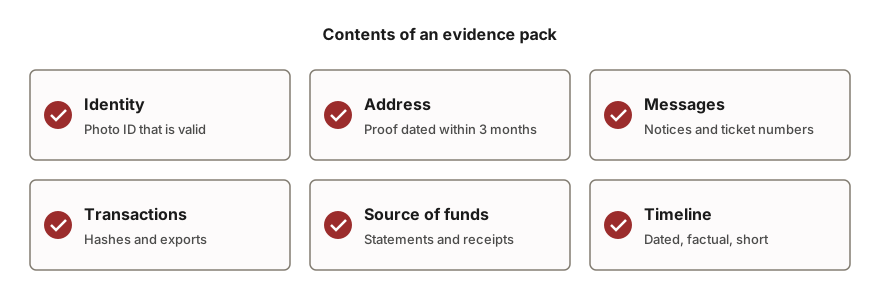
- Which wallet addresses fall within the scope, and which of those you control
- The transaction hashes, or the dates and amounts, of the transfers that matter to your case
- The precise question or request received from the platform, the bank or the lawyer
- Exports from the exchange, together with the trade history covering the period
- Bank statements or receipts showing where the funds were first purchased
- Any prior report, risk score or screening outcome that was shown to you
What our work involves
- Set out the question the report must answer
Before proceeding, the precise nature of the inquiry must be established. This scope may involve determining deposit origin, wallet history, or specific counterparty exposure. A clear question enables the reviewer to properly utilize the resulting documentation.
- Commission independent specialists to trace the transactions
Independent blockchain analysts follow the transfers on the public ledger, identify the counterparties where possible and record each hop. We select these specialists, brief them and verify that the scope matches the question you posed.
- Flag risks and describe them
The report records any exposure to categories such as exchanges, mixers, sanctioned entities or addresses tied to scams. In plain language, each flag is explained, together with the transfers that produced it.
- Compare the chain with your own records
Ledger data by itself carries little weight. Our specialists connect the traced transfers to your exchange exports, receipts and bank statements, so the submission presents one consistent account rather than a bare list of hashes.
- Prepare a document for the reviewer
What you receive is a structured report containing a summary, a path of funds, a table of transfers and a brief note on method and limits. The choice to submit it to the platform or a lawyer remains yours.
What falls outside our role
- A report traces the movement of funds on the public ledger. It does not establish who controls an address, why a payment was made, or that the funds are lawful.
- Labels attached to counterparties derive from analytics data and may be incomplete or inaccurate. We record the confidence level and its basis.
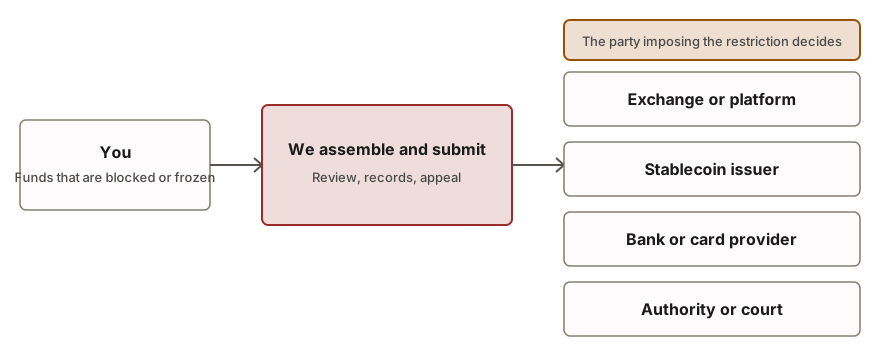
- A platform may decline to act on a report. We cannot compel any compliance team, issuer or authority to accept a submission or to revise its decision.
- Privacy tools, cross-chain bridges and trades settled off the ledger can interrupt the trace. The report identifies the point where the trail ends.
- We never request your seed phrase, private keys or passwords. Tracing requires only public addresses.
Expected timeframes
The time required depends on how many addresses are involved, how deep the trace must run, and how quickly you can provide the matching records. An estimate follows the assessment.
Fees
The assessment costs nothing. Fees for a report depend on its scope and complexity and are quoted in writing before any payment is due. No fee is requested before we state whether a report would be useful. Fees →
Frequently raised questions
What is contained in a source-of-funds report based on blockchain analysis?
The resultant record contains a comprehensive summary, outlining the fund trajectory from the earliest identified source to your specific address. This documentation includes a detailed transfer table, clearly labeled counterparties, and explanations concerning all applicable risk indicators. The report also specifies the method employed and enumerates the operational limits of the investigation. This document is prepared for a compliance reader, rather than for a technical audience.
Does a blockchain analytics report establish that my funds come from a legitimate source?
No. The report sets out where the funds moved and which labels the counterparties carry. Whether the money is legitimate also depends on how you earned or bought it, which is why the report is paired with your bank and purchase records.
Will the exchange agree to consider a report of this kind?
Whether a compliance team accepts a third-party blockchain report depends on the team and its internal procedures. Some teams rely on their own tools and treat an external report as background context. A well-organized report paired with supporting documents is generally more useful than a list of raw transactions. No acceptance can be promised in advance.
Will you require access to my wallet for this procedure?
No. Tracing is done with public addresses and transaction hashes. Never share a seed phrase, private key or password with anyone who offers you a report. A legitimate analyst has no need for such credentials.
What happens if the trace crosses a mixer or a bridge?
The report denotes the precise locus where the data path achieves uncertainty and details what is known on both sides. Certain bridges permit tracing, whereas mixers typically do not permit follow-up. The submission defines the exact limit of available knowledge, rather than offering conjecture.
Does this report differ from a risk score?
No. A risk score is a single numerical output derived from a specific screening tool. The accompanying report details the transactions that resulted in that rating. This documentation permits you to formally contest a score that does not align with the verified historical record.
Common situations
- The exchange asks for proof of source of funds on a sizeable deposit
- Coins were purchased on the open market, transferred across your own wallets, and then marked by a flag
- A payment arrived, and only afterwards did you discover the sending address carried a risk label
- A bank seeks clarification about the origin of money received from a crypto sale
- An old wallet balance requires a documented history before any use is possible
- You require an evidence exhibit to support a dispute or an appeal
Related situations
- Diagnosing who froze your crypto. Establish who froze your funds and which next step is realistic.
- Source of funds and wealth documentation packs. Build a clear source of funds and source of wealth pack for exchanges, banks and processors.
- Disputing risk flags from wallet screening. High-risk address flag from screening tools: record the funds path and dispute it.
- Tracing stolen crypto and freeze requests. Tracing of stolen crypto, with freeze requests to exchanges and issuers and a police filing.
Read next
The content on this page is general in nature and is not legal advice.