
USDT address frozen: a Tether freeze, its basis, and your next steps
Published: Last reviewed: Editorial standards
When a USDT address is frozen, the tokens remain visible upon the blockchain, but movement is impossible. The application of this freeze occurs specifically at the token level, and not through your wallet application or an exchange. Law enforcement requests or compliance flags constitute common bases for such a measure. Only the entity that initiated the freeze, or a licensed court, may successfully remove it. Attempting to transfer funds to a different wallet or to an unknown third party will not assist in lifting the hold.
Any question on your case may be put to us here:
What a frozen USDT address means in practice
USDT is issued by a company, and the smart contract gives the issuer the power to block chosen addresses from sending or receiving the token. If that measure is applied to your address, a block explorer will still display the balance. The tokens simply cannot move.
A token level freeze is not the same as an account restriction on a trading platform. The platform governs only its own service. A freeze applied to the token travels with the address, so it applies wherever the address is used. Installing a new wallet application, switching devices or moving to another exchange has no effect on this.
How to verify that the freeze is genuine
Not every failed transfer points to a freeze. In practice, low network fees, a wrong network selection or a wallet fault produce the same result. Establish the facts first, then consider what may have gone wrong.
Search for your address on the public block explorer of the network you use. Explorers frequently display a label or flag for restricted addresses, and reverted transactions often carry a reason code. Take screenshots and record the date and time.
- Confirm that you selected the correct network for the token, for example the network on which you received it.
- Confirm the wallet holds enough of the network's native coin to cover the transaction fee.
- Open the explorer, locate your address and your most recent failed transaction, and save both records.
- Only if you are certain the issue is not a fee problem, attempt a very small USDT transfer once. Do not repeat large attempts.
- Record every transaction of recent months involving the address, including counterparty and purpose.
Why addresses get frozen
For individual cases, the specific reasons are typically not disclosed. The two scenarios most commonly cited are a formal request from law enforcement or a compliance alert triggered by the issuer or its monitoring systems.
A request from authorities is commonly linked to an investigation concerning another person, for example a scam or theft. Funds may have passed between your address and an address connected to that case. A compliance flag operates in a similar way but originates from screening rather than from a court or police request. Neither pattern means an accusation has been made against you.
Which parties may remove a freeze, and which have no such power
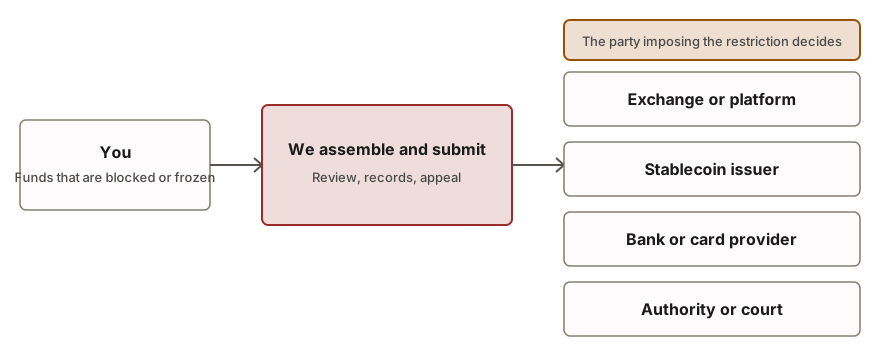
Restoration of control rests exclusively with the entity holding such authority. In practice, this includes the issuer, when reviewing the matter, or the specific authority which mandated the freeze.
Wallet providers, blockchain explorers, exchanges, and our staff do not possess the capacity to release these restrictions. Any individual or group claiming they can unfreeze your address for payment, bypassing the issuer or the authority, should be approached with caution.
Your Allowed and Prohibited Actions
You may communicate with the issuer using their official legal or support channels to ascertain the nature of the restriction and the necessary documentation. If an authority is involved, you can also retain a licensed lawyer to submit formal correspondence.
One cannot compel a decision, and attempts to bypass the existing freeze are inadvisable. Transferring any remaining asset balances through mixers or other new wallets might resemble evasion and negatively impact the review process.
- Maintain the address records, relevant explorer screenshots, and the complete history detailing the receipt of the funds.
- Compile evidence of origin including exchange receipts, documentation of bank transfers, issued invoices, and executed signed agreements.
- Access the issuer solely through the contact channels documented on its official website, avoiding links that are transmitted to you.
- Retain a written account of all communications, recording specific dates and reference numbers associated with each message.
- Do not share your seed phrase, private key, or password with any individual claiming to provide assistance.
A reasonable next step
Begin by preparing a one page timeline in writing: the date you received the USDT, the source, the purpose, and what you did with the tokens afterwards. In practice, this is the record an issuer, an authority or a lawyer will request first.
Where a substantial sum is frozen, or you believe a legal request stands behind the restriction, submit the timeline to a licensed lawyer in the relevant jurisdiction. We review the case free of charge, assemble the evidence and coordinate independent lawyers and analysts. We cannot promise that the address will be released.
Frequently asked questions
Is my USDT still visible when the address is frozen?
Yes, the funds stay visible on the blockchain and inside most wallet interfaces. What changes is that the token contract prevents outgoing transactions from that address, which means you cannot send, exchange or sell the tokens.
If my address is frozen, does that indicate a police investigation against me?
Not necessarily. A freeze may follow a request concerning another person whose funds passed through your address, or an automated compliance flag. Treat it as grounds to collect your records and seek advice, not as evidence of suspicion.
Would shifting my funds to a different wallet lift the freeze on them?
No. The frozen tokens cannot be moved, because the restriction attaches to the address itself. Opening a new wallet has no effect on them, and any fresh funds received from a flagged address can raise new questions.
How long does a USDT freeze last?
We cannot state a fixed period. Some restrictions remain in place while an authority works on a case, while others end after a review. Ask the issuer which type applies in your situation, and keep your evidence ready.
Is paying a third party to lift the freeze on my USDT safe?
Exercise caution here. Only the issuer, the authority that requested the freeze, or a court can remove it. Advance payments, assurances about the result, and any request for your seed phrase all point to a recovery scam.
How we can help
- Appealing a stablecoin issuer freeze. A documented appeal, prepared for Tether, Circle or another issuer of stablecoins.
- Wallet unblocking across networks. For frozen or flagged wallets: case preparation and presentation, from USD 50,000.
- When authorities freeze your cryptocurrency. When authorities hold your assets, we arrange independent licensed lawyers. This is not legal advice.
- Diagnosing who froze your crypto. Establish who froze your funds and which next step is realistic.
The content on this page is general in nature and is not legal advice.