
Which documents an exchange compliance team requests, and how to submit them
Published: Last reviewed: Editorial standards
As a rule, a compliance review covers four groups of papers: a current photo ID, proof of address, records showing where the funds originated and evidence that you control the wallet in question. Submit recent, complete and legible files in a single organised submission, together with a brief cover note connecting every document to the specific question raised. Do not send passwords, seed phrases or private data that was not requested.
Any question on your case may be put to us here:
Answer the request first, then gather papers
Read the request a second time before you collect any papers. The exchange states what it requires, at times in a single line. A notice asking you to refresh identity verification calls for different documents than a notice asking you to explain a large deposit.
List every question in writing. Each document you prepare should address one item on that list. Where a question seems unclear, request clarification from the exchange in writing before assembling a large submission.
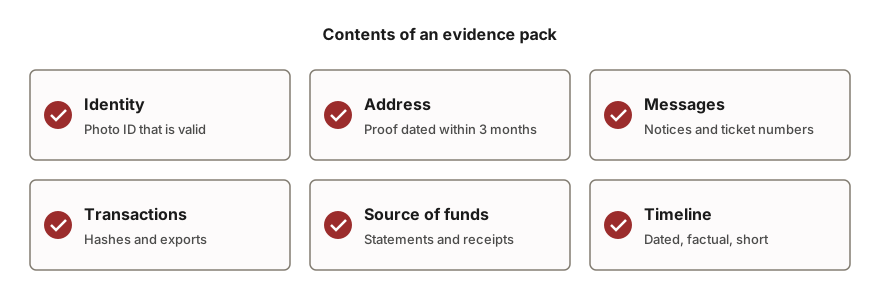
Identity and address records
These files are the least difficult to assemble, yet reviews often fail here on minor points. In practice, the reviewer checks that the name, date of birth and address match across each document in your submission.
Submit records that are current and display your name in the exact spelling used on the account. Where the name has changed, attach the record that establishes this.
- Official photographic identification that remains valid and unexpired, with each of the four corners fully visible.
- A document confirming your address, issued within the previous three months, for example a utility bill or bank statement, where the exchange requests one.
- A legible selfie or a live video verification, when the exchange asks for it, captured in adequate lighting with no filters applied.
- Documentation of a name change, for instance a marriage certificate, where the name differs across your records.
- Business registration papers together with a schedule of owners, where the account is held by a company.
Records showing source of funds
Among the document groups, this is where reviews most often slow down. As a rule, the exchange requires a paper trail running from the origin of the money to the deposit that started the review. Our separate guide explains the difference between source of funds and source of wealth.
Select records that correspond to the true origin. A salary slip alongside a bank statement evidences salary income. A prior export from an exchange plus bank transfers evidences trading activity. Where several origins are combined, present each portion separately.
- Bank statements demonstrating the movement of funds into the exchange or into the wallet.
- Statements issued by the exchange and transaction exports from platforms you used before.
- Contracts of sale, invoices, or payment receipts covering goods, services, or property you bought or sold.
- Where the funds originate from earnings, tax returns or payslips serve as supporting records.
- For any matter the documents leave open, prepare a written explanation in your own words.
Showing you control the wallet
If the review covers a self custody wallet, the exchange can require evidence that the address belongs to you. Such evidence can be provided without disclosing any secret.
Common procedures include a message signed by the address, a small test transfer of a previously agreed sum, or a screenshot of the wallet with the address visible during a live session. Use whichever procedure the exchange accepts. Never disclose your keys to anyone.
How the package looks and reads
An orderly submission suggests a dependable customer, while a disorderly one tends to trigger follow up questions and delay. Submit one file per document, in PDF format where available, named clearly, for example bank-statement-2026-03.pdf.
Attach a cover note of one page that lists each file and states which question it addresses. Keep the wording factual and brief. Avoid arguing, threatening, or complaining within that same message.
- Photograph or scan each page in colour and in full, without cropped edges or glare.
- Leave every document unedited and unredacted unless the exchange has expressly permitted you to conceal something.
- Compress files to fit the upload limit rather than dividing one statement over several images.
- Use only the channel named in the ticket for your submission, and retain the reference number.
- Retain copies of each submission together with the date it was sent.
Materials to withhold
Volume is not a virtue here. Submitting surplus private data exposes you to risk and buries the reviewer in noise. Send nothing beyond what the request lists, unless an item directly clarifies a specific point.
When interacting with any compliance team, you must never transmit your seed phrase, private key, wallet passwords, one-time codes, or remote access credentials to your computer. Such sensitive information is not required by legitimate authorities. Additionally, you must not submit documents that you have altered, nor should you send documentation that belongs to another party without securing their written consent.
Frequently asked questions
What is the maximum age accepted for a proof of address document?
As a rule, many exchanges request a document dated within the past three months, although the requirement varies between platforms. Read the exact wording of the request. Where no period is stated, in practice the newest document available to you is the appropriate submission.
May I cover sections of a bank statement before submitting it?
That depends on the exchange's terms. As a rule you can obscure transactions that are not related to the request, but your name, the account number or IBAN, the date range and the lines in question must remain readable. In practice it is safer to ask in writing first, because a visibly altered file may be refused.
What happens if records for an older transaction are missing?
State this plainly and provide the nearest substitute evidence, for example an export from the exchange at the time, a bank record or a signed statement from the counterparty. An honest explanation carries more weight than a fabricated document.
Is it better to submit everything together or in stages?
In practice one complete submission is preferred, answering each point raised in the request. Partial replies sent repeatedly tend to cause confusion and may reset the review deadline. Where part of the request cannot be met, say so in the cover note.
Do my documents need to be translated?
A translation is often accepted, provided it is in a language the exchange recognizes. Ask the exchange whether a plain translation is sufficient or whether a sworn one is required. In practice, a sworn version is the safer choice when the submission is formal. Attach the original file beside the translation so the reviewer can compare them.
How we can help
- Source of funds and wealth documentation packs. Build a clear source of funds and source of wealth pack for exchanges, banks and processors.
- Unblocking an exchange account. Understand the restriction, prepare KYC and AML evidence, reply and appeal.
- Diagnosing who froze your crypto. Establish who froze your funds and which next step is realistic.
- Disputing risk flags from wallet screening. High-risk address flag from screening tools: record the funds path and dispute it.
The content on this page is general in nature and is not legal advice.