
Funds lost through a DeFi exploit, a bridge hack or a malicious approval: what action is actually possible
Published: Last reviewed: Editorial standards
On-chain transactions cannot be undone. As a rule, assets taken in a DeFi exploit, a bridge hack or through a malicious approval are not recovered. In a limited set of situations there is a window to act: stolen funds may reach an exchange, a stablecoin issuer or a protocol that can pause its contracts. Acting quickly and having a clean trace are what count here. We assist with mapping the flow, notifying the appropriate parties and filing reports in the proper form. No return of funds can be promised.
Any question on your case may be put to us here:
Who this service is meant for
- A transaction you signed, via a malicious contract or approval, drained your wallet
- A DeFi protocol or cross-chain bridge was exploited, resulting in lost funds.
- A fraudulent site or airdrop induced you to grant token permissions
- You require a documented trace and a report suitable for exchanges, protocols or police
The procedure for a case
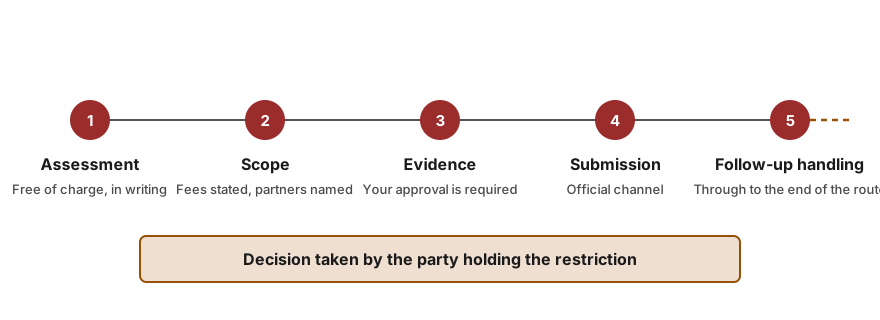
- Free initial assessment
Describe what you signed, when it occurred and the wallet addresses concerned. We answer in writing with an honest assessment of whether a trace could lead anywhere and whether our assistance is possible.
- Written scope and fee summary
Should we proceed, you receive the scope in writing, the fee model and the independent analysts who will carry out the tracing. No charge is made before you have accepted it.
- Identify and document
Analysts trace the movement of the assets and prepare a plain summary of the route. It shows the points where funds might still be recoverable and the points where they are permanently lost.
- Alerts and submissions
The alerts are sent and the report for the authority is prepared. You receive copies of every submission and any reference numbers returned.
- Review and closure
You are updated on responses and told clearly once the case reaches the end of the available options. We do not keep a case open in order to collect fees.
What to prepare
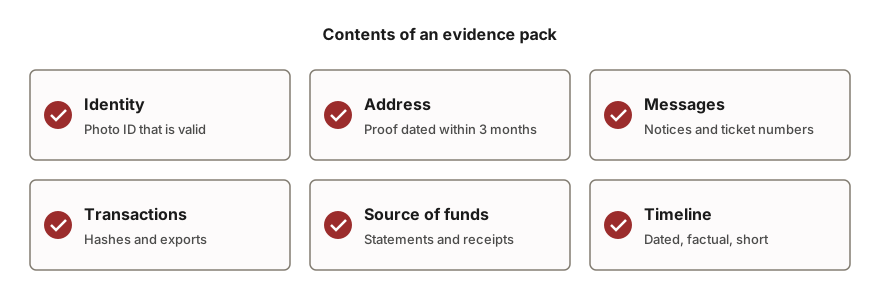
- The addresses to list: your own wallet, the attacker's address where this is known, and the relevant contract address
- The hashes for the approval transaction, the theft transaction and any movement of funds that followed
- Photographs or screenshots of the website, message or application that prompted you to sign
- A record of your balances before the incident, taken from the exchange or your wallet application
- Chat logs or emails exchanged with the project, support staff or the attacker
- Records showing how you obtained the lost assets, if you have them
- A written timeline from first contact through discovery of the loss
What our work involves
- Protect remaining funds
This involves revoking token approvals and transferring remaining assets to a new wallet established by you. This procedure must be performed using your personal device. Your private keys or seed phrase will never be requested.
- Follow the stolen funds
Independent analysts track the funds from your account through swaps, bridges, and mixers to identify points of stabilization. These points include stablecoin holdings, exchange deposits, or frozen contracts.
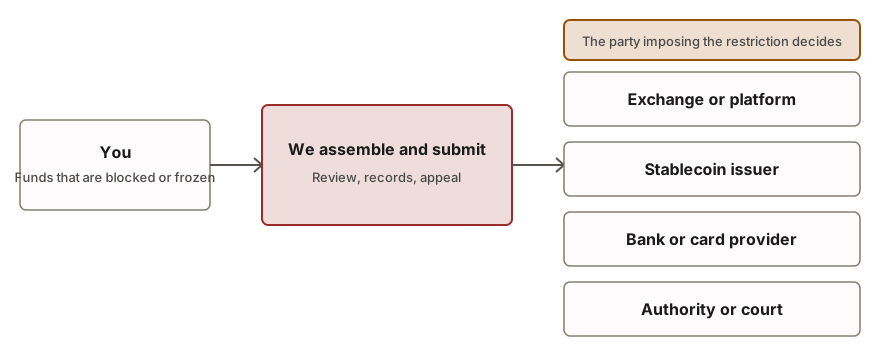
- Notify exchanges, issuers and protocols
When the trace points to a destination capable of action, we draft a concise notice containing transaction hashes, the wallet addresses and a brief summary. This submission goes to the exchange, issuer or protocol team that has the authority to pause or flag.
- Prepare the report for the authority
We assemble the incident into a factual report containing a timeline, a loss figure and the supporting evidence. You may file it with the police or, where your country offers one, with a cybercrime unit.
- Review legal avenues
Where the attacker can be identified or a company is involved, we introduce an independent lawyer able to advise on claims, court orders and cross-border measures. That advice is provided under the lawyer's own engagement.
What falls outside our role
- Once a transfer is recorded on-chain, it cannot be undone. We have no ability to reverse a transaction, and no power to compel an exchange, issuer or protocol to freeze or return assets.
- The possibility of recovery is restricted in most DeFi and bridge instances. We do not pledge any return and refrain from accepting situations that lack a realistic path forward.
- The scope of this procedure does not include hacking or direct negotiation with exploit perpetrators on your behalf.
- Under no circumstance will we request your private keys, wallet passwords, or seed phrase access.
Expected timeframes
Timelines are measured in weeks for tracing and follow-up actions, although speed is important during the initial hours. Responses from various exchanges and protocols are variable. An estimate will be provided following the assessment, and that estimate will be updated should circumstances change.
Fees
The initial assessment is provided without cost. Subsequent to that, you will receive a written declaration of scope and the specific fee model for your case. A fee is never requested until after we have informed you whether we are able to provide assistance. Fees →
Frequently raised questions
Is it possible for funds lost during a DeFi hack to be recovered?
Recovery is rarely possible. Primarily, recovery occurs when the stolen assets reach a stablecoin issuer or an exchange capable of intervention, or when a protocol arranges a return. Most assets are swapped or mixed so quickly that recovery does not occur.
Can a blockchain transaction be undone?
No. Once a transfer is confirmed on-chain, no party, including us, can reverse it. Any recovery rests with third parties who may choose to freeze or return the assets, and their decision is entirely at their own discretion.
What is the first step after approving a malicious transaction?
Revoke that approval with a reputable tool, transfer any remaining funds to a new wallet set up on a clean device, and keep a record of the transaction hashes. Ignore recovery offers you receive from strangers, since many of them are scams.
Why do you warn readers about recovery scams?
Victims of crypto loss are frequently approached by fake services demanding an upfront payment or a seed phrase. Legitimate assistance never requests your keys. No outcome is promised by us either.
Is a bridge hack different from theft from a wallet?
Yes. A bridge incident as a rule affects many users simultaneously, and the project may operate its own compensation or recovery procedure. The reasonable course is to monitor official project channels and preserve records of your holdings.
Should the incident be reported to the police?
In most cases, yes. A police report supports later submissions to exchanges and can back insurance or tax filings. Prepare a clear timeline, the addresses and the hashes. Cybercrime units, in practice, handle such reports differently in each country.
Common situations
- Your wallet was emptied after connecting to a counterfeit website and approving a token spend
- Assets lost due to an exploited or drained protocol liquidity position.
- Funds that are stuck or stolen as a result of a cross-chain bridge attack.
- Assets subject to a rug pull where the development team drained liquidity and departed.
- A malicious NFT or token initiating an unintended hidden approval of your holdings.
- Tracing stolen funds as they move into an exchange deposit address.
- An attacked wallet where an adversary has already initiated asset swaps.
Related situations
- Tracing stolen crypto and freeze requests. Tracing of stolen crypto, with freeze requests to exchanges and issuers and a police filing.
- Report on blockchain transaction analysis. A source-of-funds report based on transaction tracing, prepared in a form a compliance team can review.
- When authorities freeze your cryptocurrency. When authorities hold your assets, we arrange independent licensed lawyers. This is not legal advice.
Read next
Sources
Authoritative and official pages on which this page relies. Such pages are updated, so confirm the current wording at the source itself.
The content on this page is general in nature and is not legal advice.