
USDC address blocked: how the Circle blacklist works and what you can do
Published: Last reviewed: Editorial standards
An issuer can place a USDC address on its blocklist. The tokens then stop moving, although the balance still appears on-chain. Circle is the party that decides this. A legal order, sanctions screening or risk flags can be the basis. Wallets, exchanges and block explorers have no power to reverse it. In practice, the route forward is a documented submission to the issuer, as a rule with a lawyer's involvement.
Any question on your case may be put to us here:
Signs the restriction sits on the address, not the app
Your wallet displays the USDC balance, yet each transfer attempt fails. Swaps through decentralised services do not go through either. Other tokens held in the same wallet move without any issue. This pattern indicates a restriction at the level of the USDC contract, not a fault in your wallet application.
Before concluding that a blacklist applies, exclude routine explanations. An incorrect network, no gas in the wallet and network congestion each cause failed sends.
- Send a small quantity of a different token from the same address. If that succeeds, the wallet itself is working.
- Open the explorer entry for the transaction that failed and study the error message shown there.
- Where the chain data permits it, check the USDC contract page for that address among its blocklist events.
- Keep screenshots, each showing the date and the time.
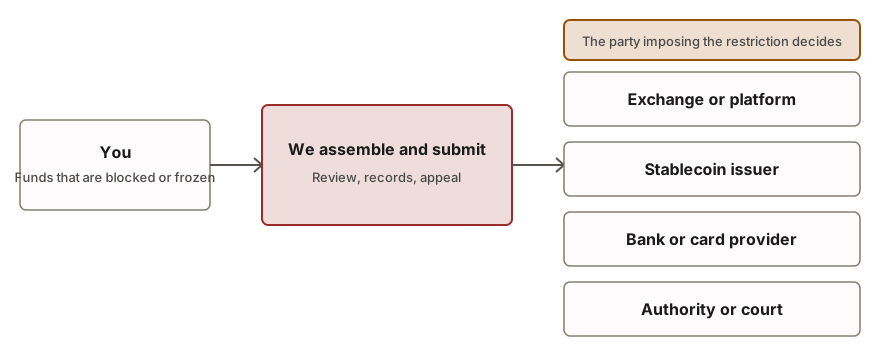
How issuer blacklisting works in general
USDC is a centrally issued stablecoin subject to regulation. Its contract contains a function allowing the issuer to place an address on a blocklist. Once an address is added, that address can no longer send or receive the token on the network in question.
This is a built-in feature of fiat backed stablecoins, not a defect and not the result of a hack. The purpose is to let the issuer comply with legal orders and sanctions requirements. A consequence is that a decision taken in one office can freeze funds in a wallet that only you control.
What usually triggers a blocklisting
The issuer seldom gives reasons for individual decisions. Public discussion suggests the triggers fall into several groups. Read this list as a map of possible causes, not as a diagnosis of your own situation.
- An order from a court, or an instruction from a public authority connected to an investigation.
- Sanctions screening, where the address appears connected to a listed individual or service.
- Exposure, identified through blockchain analytics, to addresses associated with fraud, theft or hacks.
- A request made by a partner exchange or by a financial institution that processes the token.
Who decides, and on what basis
The issuer holds the decision, and in some cases the authority that issued a request does. As a rule, neither will discuss the matter with any third party who lacks a mandate from you.
A review usually examines the source of the funds, who controlled them before you, and whether you can document a clear commercial or personal purpose behind each transfer. Gaps in that account are what delay a case. Records showing the lawful origin of the funds carry the greatest weight.
Steps available to you
The primary route is a written submission to the issuer, filed through its official legal or support channel, stating your identity, the address, the relevant dates and the proof of origin. Where an authority is involved, the submission may have to proceed through a lawyer licensed in that jurisdiction.
Outcomes differ from case to case. The address may be unblocked, may remain blocked, or the issuer may state that only a court can rule on the matter. No result can be promised, and we cannot compel the issuer to act.
- Prepare a chronology showing how the USDC reached the address.
- Gather supporting records: exchange statements, bank transfers, invoices and contracts.
- Demonstrate control of the address in a manner that does not expose your keys, for instance by producing a signed message.
- Submit a single full request rather than several partial submissions.
- Never disclose a seed phrase, private key or password to any party.
What to avoid while you wait
Sending test transfers from flagged funds to fresh addresses is not advised, and neither is mixing or bridging assets you still control. In practice, such actions raise new questions and may appear as efforts to conceal the source.
Treat with caution any message asserting ties to the issuer, or any paid offer to remove your address from a blocklist. Should you want another review of your paperwork before contacting the issuer, we provide a free assessment and can involve independent lawyers.
Frequently asked questions
Can an exchange release my blocked USDC?
No. An exchange has no authority to set aside a restriction written into the token contract. Its decisions concern only funds held on its own platform. In practice, the party able to alter the status of the address is the issuer.
Is a Circle blocklisting permanent?
We cannot state that. As a rule, some restrictions are lifted after a review, while others remain in place for the duration of an open legal matter. The issuer or a court determines the result, so direct your enquiry about your address to the issuer.
Am I entitled to an explanation from the issuer about the block on my address?
In many cases you will receive only a general explanation, and on occasion no explanation at all, particularly where the block was requested by an authority. A licensed lawyer may obtain fuller detail through a formal written request than a private individual can.
Can new USDC still arrive on the blocked address?
As a rule, no. An address on the blocklist is restricted in both directions, for sending and for receiving. Do not ask other people to transfer funds to it, since those funds may also become stuck.
Is a lawyer required before I reach out to the issuer?
Not in every case. For simple matters, a written submission supported by solid evidence may be sufficient. A lawyer becomes useful where the amount is large, where an authority is behind the block, or where your first request has gone unanswered.
How we can help
- Appealing a stablecoin issuer freeze. A documented appeal, prepared for Tether, Circle or another issuer of stablecoins.
- Wallet unblocking across networks. For frozen or flagged wallets: case preparation and presentation, from USD 50,000.
- Report on blockchain transaction analysis. A source-of-funds report based on transaction tracing, prepared in a form a compliance team can review.
- Sanctions and AML false positive help. If a sanctions or AML flag is a false match, we prepare your evidence and a lawyer files the statement.
The content on this page is general in nature and is not legal advice.