
Tether (USDT) frozen or blacklisted address: the official sources explained
Published: Official pages last read: Editorial standards
The terms allow Tether to freeze tokens where the law requires it or where it judges this prudent, and to blacklist an address connected to suspected prohibited use. Requests come, per its own pages, from governments, law enforcement and courts. No appeal procedure is described anywhere we reviewed. Theft, hack and scam matters go to its information requests team, so collect your evidence first and disregard anyone offering a paid unfreeze.
We operate independently of Tether (USDT) and have no affiliation with it. We have no ability to affect its decisions, and nothing on this page constitutes an official statement of Tether (USDT).
Any question on your case may be put to us here:
Review of the exchange's own published terms
- Under the terms, Tether and its associates accept information requests from governments, law enforcement agencies and courts, and personal information may be shared when ordered or where that seems reasonable and necessary. [1]
- The terms permit Tether to freeze tokens where applicable law requires this or where it considers it prudent, and to suspend access at a government's direction or where a wallet faces pending litigation, investigation or government proceedings. [1]
- For suspected prohibited use, the terms list as sanctions the freezing or confiscation of funds or tokens in a wallet and blacklisting of any address holding Tether tokens, and they state reports to authorities may occur without notice to the user. [1]
- The terms oblige Tether to report to bodies such as FinCEN and OFAC. They set out no criteria for blacklisting an address, no request procedure, no required documents and no appeal process. [1]
- According to the terms, questions about prohibited uses are directed to the customer support site that Tether's terms name. [1]
- According to Tether's official recovery page, legal matters involving law enforcement inquiries, theft, hacking incidents, fraud, or comparable situations must be submitted to the Tether information requests team. [2]
- The recovery page also addresses tokens sent by mistake to unsupported destinations, stating that recovery is discretionary, is evaluated first, may be refused and cannot be guaranteed. [2]
- The page states that these discretionary recoveries carry a fee of up to 10% of the recovered amount, or 1,000 dollars if that is greater. A verified user is required, and the page notes that such cases can take several months. [2]
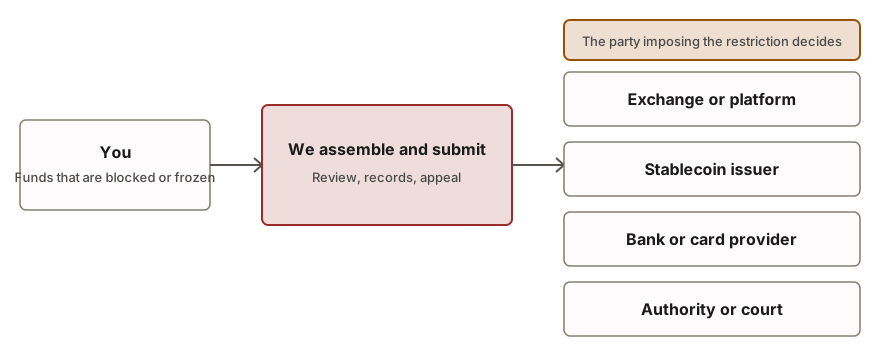
Common Regulatory Restrictions
| Type of restriction | What it means |
|---|---|
| Frozen address flagged | As a rule, the terms treat blacklisting of an address holding Tether tokens as a sanction for suspected prohibited use. However, the terms do not state the criteria applied or how an address may be reviewed. |
| Freeze due to a legal demand | Tether states that it may freeze tokens as the law requires and that it receives requests from governments, law enforcement bodies and courts. Under the terms, the user may not receive notice of such a freeze. |
| Suspension pending review | The terms give Tether the authority to suspend access to an address in two situations: when a government directs the company to act, and when a wallet is linked to litigation, an investigation or official proceedings that are still under way. |
| Funds sent to an incorrect address | This situation differs from a frozen address and involves a discretionary procedure for mistaken transfers, which necessitates evaluation and involves a fee. |
Procedure for Required Actions
- Determine which type of issue applies
Addressing a frozen address, wrong transfers, or theft requires distinct procedures and distinct jurisdictional routing, so record which specific scenario applies to you.
- Gather your facts in written form
You must document the recipient address, the specific token, all transaction hashes, and relevant dates and amounts. The recovery page requires this information specifically as text, not images.
- Establish who imposed the restriction
In practice, you should query your exchange or custodian regarding whether the limit pertains to your specific account or to the address itself.
- Direct legal questions to Tether's official channels
Tether’s recovery page refers matters involving theft, hacking, or law enforcement to its information request team; the published pages do not detail an appeal form.
- Contact the recipient before Tether
In cases of a mistaken transfer, the recovery page suggests asking the party who received the tokens to send them back before you approach Tether, and points out that this route is often faster.
- File a police report and retain all records
Where tokens were taken from you, submit a report to the police and record the number assigned to it. Tether's own pages state that it handles requests coming from authorities, not from private individuals.
What to prepare
- The wallet address involved, and the token name, in written form
- Transaction hashes, along with dates and amounts, for each transfer that is relevant to the case
- Documentation showing the address is yours, for instance a signed message or records from the exchange
- Records showing the origin of the funds, for example purchase receipts and bank statements
- Any notice you have been sent by a platform or by an authority
- The number of a police or fraud report, if theft plays a part in the matter
Potential Hazards and Fraud Prevention
- Anyone offering to unfreeze USDT should never receive your seed phrase, private keys or passwords, and you should not connect your wallet to any site claiming it can lift a blacklist.
- Treat with caution anyone who claims to hold a private route inside Tether. No one outside Tether can lift a blacklist on request.
- Avoid paying anything upfront to a service promising to unfreeze an address. Tether's own pages describe no such third-party route.
- Do not route remaining funds through unfamiliar services to dodge a freeze. New transfers can add further activity that must later be explained.
Circumstances Requiring External Counsel
- The freeze seems to rest on a request from an authority or an ongoing investigation
- A substantial balance stays locked, and your platform cannot identify who imposed the restriction
- A platform or a lawyer may ask for documentation showing where the funds came from, so prepare a report that records that origin
- A scam or a hack left you needing to organise evidence for the police without delay
Frequently raised questions
Can Tether freeze my USDT?
Under Tether's terms, the issuer may freeze tokens where required by law or where it judges this prudent, and may blacklist an address connected to suspected prohibited use. Those terms also state that the issuer receives requests from governments, law enforcement and courts.
Can an appeal be filed after Tether freezes an address?
The public pages we reviewed describe no submission or appeal procedure for addresses that are frozen or blacklisted. According to those pages, matters such as theft, hacks, scams and requests from law enforcement are directed to the information requests team. In practice, this depends on the jurisdiction and the terms you accepted, so consult a licensed lawyer about the proper route.
Does Tether give advance notice to the holder before an address is frozen?
Under the terms, reports to the authorities may be submitted without notice to the user. No advance warning before a freeze is promised, so as a rule you may find out only when a transfer fails to go through.
I transferred USDT to an address that is not mine. What happens now?
The Tether recovery page states that you should first ask the party who received the funds for assistance. It sets out a discretionary procedure for limited cases that includes an evaluation step, a fee of up to 10% or 1,000 dollars, and it does not promise any outcome.
Can an exchange unfreeze my USDT?
The exchange can lift a restriction applied to your account with it, but it has no authority to remove a blacklist set at issuer level. Start by asking the exchange, in writing, whether the limit applies to your account or to the address itself.
Is it possible for a recovery service to have USDT unfrozen for payment?
Treat such offers with great caution. Tether's pages describe no route through third parties, and unsolicited offers to unfreeze or recover funds follow a common scam pattern. Never disclose keys or passwords, and never pay in advance.
Is this page operated by Tether?
No. We operate independently of Tether and have no affiliation with it. Our service summarises Tether's published pages, links to them, and holds no ability to influence any decision concerning an address.
Related services
- Appealing a stablecoin issuer freeze. A documented appeal, prepared for Tether, Circle or another issuer of stablecoins.
- Wallet unblocking across networks. For frozen or flagged wallets: case preparation and presentation, from USD 50,000.
- Tracing stolen crypto and freeze requests. Tracing of stolen crypto, with freeze requests to exchanges and issuers and a police filing.
Read next
Official pages read
Authoritative and official pages on which this page relies. Such pages are updated, so confirm the current wording at the source itself.
- Tether legal terms, law enforcement requests tab · Tether
- Tether tokens Recovery · Tether
The content on this page is general in nature and is not legal advice.