
Can stolen crypto be frozen? When a freeze works, and when it does not
Published: Last reviewed: Editorial standards
Sometimes. Freezing becomes possible only where a control point exists: an account held at an exchange, or a stablecoin such as USDT or USDC, whose issuer has the technical ability to block an address. Bitcoin or Ether held in a self-custody wallet is beyond anyone except the holder. In practice, stolen funds often move onward within hours, so a prompt report with solid documentation matters. It improves the odds but makes no outcome certain.
Any question on your case may be put to us here:
A freeze requires someone with the power to refuse
A payment on a crypto network cannot be undone, because no central office exists for that purpose. In practice, a freeze occurs only if the entity holding the funds, or the issuer controlling the token, decides to block them.
For that reason, the real question is not whether crypto can be frozen as a general matter. What matters is the present location of the stolen funds, and whether a company positioned at that location has both the capacity and the readiness to act.
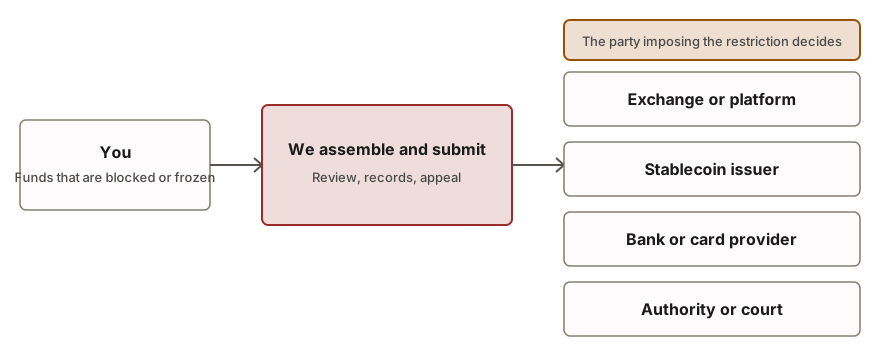
Where a freeze is realistic
Two main situations make a freeze genuinely possible. In both, a party other than the thief holds a lever to pull.
- An exchange account: when the thief sends the stolen funds to a regulated exchange, that exchange may restrict the account during its review of a credible report.
- A stablecoin with an issuer freeze: certain issuers hold the power to blacklist an address, after which the tokens held there cannot move.
- A payment service or broker through which the thief intends to cash out, provided the report arrives early enough and reaches a compliance team that actually reads it.
- A bank account at the far end of the chain, where the bank can hold or recall a payment under rules of its own.
Where a freeze is not possible
Coins that exist natively, such as Bitcoin and Ether, and that sit in a wallet controlled by the thief, cannot be frozen. A private key kept on a device belonging to the thief is not something an exchange, an issuer or a court can block.
As long as the funds remain in that type of wallet, the practical course is to trace them until they reach a service with a control point. That may take days or weeks, and it may never occur.
Funds routed through mixers, cross-chain bridges or a long series of newly created wallets are more difficult to trace. Difficult does not mean impossible, but you should expect gaps in the record.
Why speed matters so much
A thief intending to cash out will, as a rule, move the funds several times within a short window. Every hop lengthens the trail and places the parties who could act further away.
Submission of a report to the exchange while the funds remain in an account is more likely to result in action than a later submission. The required details for action must include transaction hashes, involved addresses, time data, and a brief factual account of the event.
Be aware that even a prompt submission constitutes a request for action rather than an enforceable order. The issuer or exchange determines whether to freeze assets, and often this requires documentation such as a police or court order.
Procedures to Execute During the Initial Hours
Maintain clear and straightforward records throughout this process. Do not attempt to recover funds yourself, nor should you pay any party offering a swift resolution.
- Document the transaction hashes, wallet addresses, amounts, and specific times for each transfer that exited your controlled wallet.
- Capture photographic evidence of any involved messages, websites, or profiles prior to their potential removal from the internet.
- Report the incident to the applicable law enforcement agency and the platform utilized, retaining all generated reference numbers for these submissions.
- If you maintain control over any remaining assets, transfer those funds into a fresh wallet that was established using an uncompromised device.
- You must never disclose your seed phrase, private key, or password to any individual, especially those who contact you offering recovery assistance.
Procedure Basis and Subsequent Action Items
Many instances result in either a partial freeze or no change. A freeze differs from recovering capital. Locked funds remain pending until an exchange, issuer, or court determines the resolution.
We provide a free case assessment. We investigate fund movement, prepare clear evidence packs, and draft reports with independent specialists. We cannot force an exchange or issuer to act, and we do not promise an outcome.
Frequently asked questions
Can someone freeze Bitcoin that has been stolen?
Bitcoin cannot be frozen while residing in a private wallet controlled by the thief. Because it possesses no central issuer or universal switch, it can only be frozen after interacting with a service, such as an exchange, that agrees to restrict an account.
Can Tether or USDC be frozen following a theft?
It is technically possible because issuers of these stablecoins can block an address. Whether such an action occurs depends upon their rules, your submitted evidence, and usually a formal legal or police request. This process occurs without automation.
Given the speed of transactions, what is the appropriate deadline for reporting a theft?
You should report the theft as quickly as possible. Thieves usually move stolen funds within hours. Even a concise factual report containing transaction hashes sent the same day is more effective than a lengthy one submitted a week later.
If a crypto fund is frozen, what is the procedural pathway to obtaining its release?
Recovery is not automatic. A freeze only serves to prevent the funds from being transferred. Returning the funds to the victim generally requires verified proof of ownership and often mandates a legal order, making the procedure a protracted affair.
Does filing a police report make a difference?
In many situations, yes. As a rule, exchanges and issuers give quicker attention to a report that carries a reference number from law enforcement, and certain ones will not begin any procedure without it. Record the number and provide it in writing when you contact them.
How we can help
- Tracing stolen crypto and freeze requests. Tracing of stolen crypto, with freeze requests to exchanges and issuers and a police filing.
- Report on blockchain transaction analysis. A source-of-funds report based on transaction tracing, prepared in a form a compliance team can review.
- Appealing a stablecoin issuer freeze. A documented appeal, prepared for Tether, Circle or another issuer of stablecoins.
- When authorities freeze your cryptocurrency. When authorities hold your assets, we arrange independent licensed lawyers. This is not legal advice.
The content on this page is general in nature and is not legal advice.