
USDT or USDC address frozen: how an appeal to the issuer is prepared
Published: Last reviewed: Editorial standards
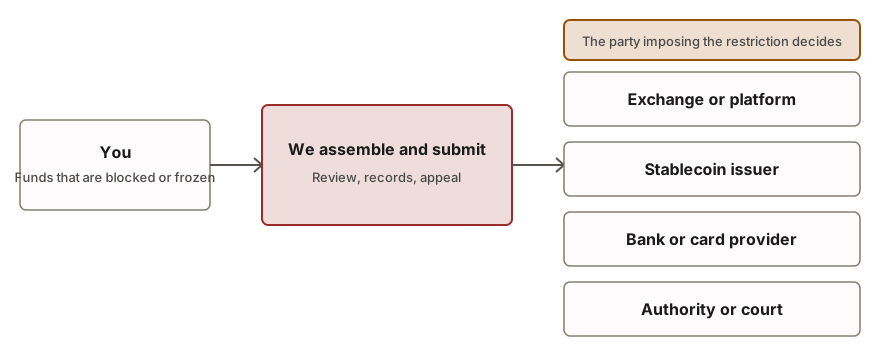
Once a stablecoin issuer such as Tether or Circle freezes an address, the tokens stay in place, although the wallet is still yours. As a rule, issuers act on legal process or on a compliance flag, which is why an informal support ticket seldom succeeds. The realistic route is a written appeal backed by evidence, sometimes with counsel. We prepare and present it, but the decision remains with the issuer.
Any question on your case may be put to us here:
Who this service is meant for
- Your USDT or USDC cannot be moved, and you suspect that the address has been blacklisted
- A block explorer or a wallet reports a freeze status against your address
- The tokens came from another person, and the address was frozen only afterwards
- An exchange says the issuer froze the funds but offers no further detail
- Your support ticket to the issuer drew a template reply, or no reply at all
The procedure for a case
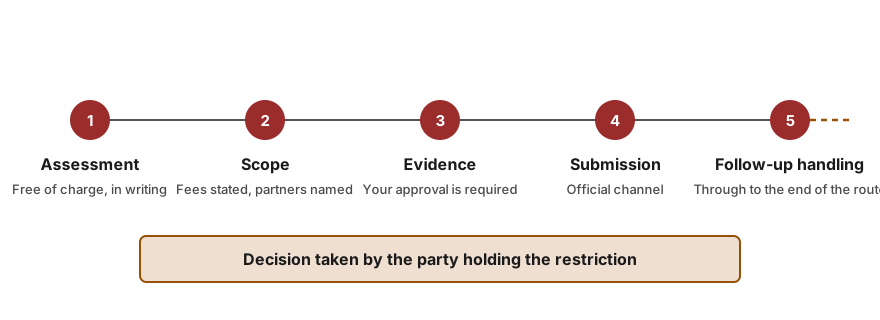
- No-charge assessment
You provide the address, the transaction hashes and whatever the issuer or exchange has said. We state in writing whether an appeal looks realistic.
- Scope and fee, in writing
Should we proceed, the scope, the fee model and the independent specialists or lawyers concerned are set out for you ahead of any payment.
- Drafting with evidence
Documents arrive through a secure channel. We prepare the appeal together with its exhibits, and the final text is not used until you approve it.
- Lodging the appeal
The appeal is lodged through the issuer's official route, and you receive a copy and all reference numbers.
- Follow-up and closure
We monitor replies and answer any further questions. When the case has gone as far as it can, we tell you so directly.
What to prepare
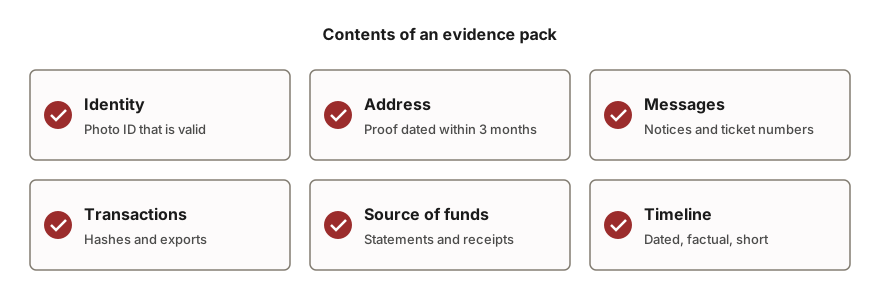
- The frozen wallet address and the relevant token contract
- Hashes of the transactions that delivered the tokens to the address
- A government photo ID and a proof of address
- Records showing how the funds were acquired, such as bank transfers, receipts or invoices
- Any message about the freeze from the issuer, an exchange or an authority
- Chat logs or a contract for the trade, where a counterparty supplied the tokens
- A brief timeline, written by you in your own words
What our work involves
- Verify that the issuer holds the restriction
Before an appeal is drafted, we examine the on-chain status of the token at your address and exclude other explanations. If the issuer did not impose the block, an appeal addressed to it would only consume time.
- Reason towards the probable ground
Freezes frequently trace back to a request from law enforcement, a sanctions screening match or an internal compliance flag. We study the address history and its counterparties and give you a reasoned view of which applies.
- Compile the evidence file
The file holds proof of how the funds reached you, a timeline of transactions, evidence of identity and ownership and, where useful, a tracing report by independent analysts. All of it is checked for consistency before dispatch.
- Write the appeal and submit it
The appeal is a factual document: it identifies you, narrates what happened, states the outcome requested and lists the attachments. It goes through the issuer's official contact route, and we retain every reference number.
- Involve counsel when the facts demand it
Where legal process lies behind the freeze, an appeal by itself may fall short. Independent licensed lawyers, whom we coordinate, advise you and act as required. We are not a law firm.
What falls outside our role
- An issuer cannot be compelled by us to unfreeze an address. It decides within its own rules and the legal orders it has received.
- Where a court or authority order underlies the freeze, only that body can alter it, normally through a lawyer.
- No result and no timeline is promised, and a case that we think has no realistic route is declined.
- Documents are never altered or backdated with our help. Where evidence does not exist, we say so.
- Your seed phrase, private keys and passwords are never requested by us.
Expected timeframes
Issuers may take weeks or longer to respond, and some appeals receive no answer. A case tied to legal process moves at the pace of that process. A rough estimate follows the assessment.
Fees
The assessment carries no charge. A written scope and fee model follow it. Any lawyer quotes fees separately, and no fee is requested from you before we have said whether we can assist. Fees →
Frequently raised questions
Is it possible for Tether or Circle to unfreeze my address?
In technical terms an issuer controls the tokens it creates, but whether it acts depends on its own decision and on any legal order behind the freeze. We cannot predict what a given issuer will do. What we offer is the most thorough honest case that the facts allow.
What leads issuers to freeze an address?
Typical grounds are a request from law enforcement, a sanctions match or a compliance flag connected with fraud. The holder is often not told which applies, so the first step is a reasoned view drawn from the history of the address.
Is it enough to email the issuer's support team?
You may do so, yet a brief complaint seldom helps, and a poor first message can complicate what follows. A structured appeal with evidence is normally the better first contact. Keep every reply in writing.
Is a lawyer needed for a stablecoin freeze?
Not in every case. Where the freeze rests on a court or authority request, or the sum is large, a lawyer is often required. We coordinate independent lawyers and tell you when that stage arrives.
What if the frozen address belongs to someone else?
A fraud victim whose funds sit at another person's address follows a different route. It generally passes through a police report and legal process, and not through an appeal by the holder. We explain which path fits your facts.
Does moving my other funds away make a difference?
Moving unrelated funds may be sensible, but any transfer to or from the frozen address can link new addresses to it. Consult us before you make transfers that might worsen the position.
Common situations
- Tokens arrived from an address later connected with fraud or sanctions
- An authority requested the freeze, and nobody informed you
- A peer to peer trade was made with a counterparty who later proved to be flagged
- A business wallet containing customer payments was frozen and no reason was given
- The funds sit at an exchange deposit address that the issuer has restricted
- You were defrauded, the frozen address belongs to someone else, and you wish to claim the funds
Related situations
- Diagnosing who froze your crypto. Establish who froze your funds and which next step is realistic.
- Wallet unblocking across networks. For frozen or flagged wallets: case preparation and presentation, from USD 50,000.
- When authorities freeze your cryptocurrency. When authorities hold your assets, we arrange independent licensed lawyers. This is not legal advice.
- Report on blockchain transaction analysis. A source-of-funds report based on transaction tracing, prepared in a form a compliance team can review.
Read next
Sources
Authoritative and official pages on which this page relies. Such pages are updated, so confirm the current wording at the source itself.
The content on this page is general in nature and is not legal advice.