
Determining the Difference Between an Exchange Freeze and a Legal Seizure: A Procedural Guide
Published: Last reviewed: Editorial standards
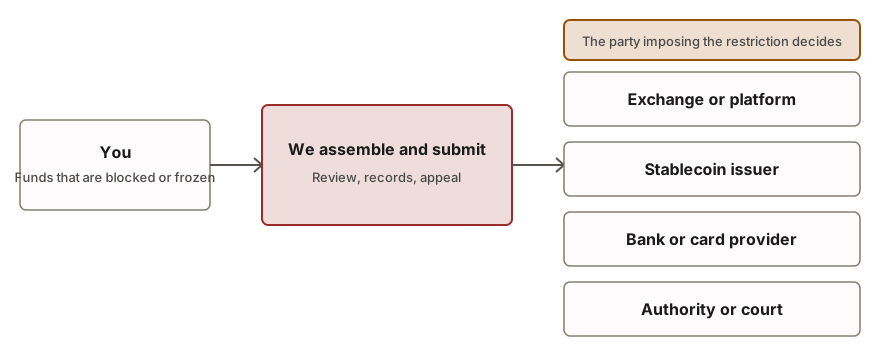
A platform compliance freeze is an internal company action based upon its established terms. A seizure or legal freeze originates from a judicial decree, prosecutor, or other external authority. The official notice usually states which procedure is in effect by providing a case or order reference and specifying the authority involved.
Any question on your case may be put to us here:
Who decides, and why it matters
When an exchange implements a compliance freeze, the platform exercises its own judgment to restrict account activity. This decision occurs while the issuer verifies KYC, examines the source of funds, or flags potential risks.
In a legal seizure or freeze, an external authority determines the action, and the exchange is merely required to execute that official instruction. The platform does not determine the basis for the restriction.
Indicators that distinguish one type from the other
No single observation is definitive, so you must examine the entire notice and every communication that follows.
- A compliance freeze typically shows up as a message that requests documents, refers to a review or verification, and tells you how to reply.
- A legal freeze or seizure typically appears as a notice citing an order, a case number, an authority or a request, with little further detail.
- A compliance freeze usually gives you a defined next step. A legal freeze usually does not, since the platform may be barred from explaining anything.
- When support states it cannot comment or cannot view the reason, in practice this usually points to a separate internal team, or to an authority, being involved.
- Direct contact from an investigator or an authority, whether by letter, email or call, indicates a legal track. Take it seriously and confirm the sender is genuine.
Why the difference matters
A compliance freeze can often be closed out by supplying whatever the platform has requested. The platform has no power to lift a legal order. Forwarding further documents to the exchange does not alter an order and may only postpone the step you actually need to take.
Contacting a law enforcement body can have legal implications. Any statement or material you provide could become part of the record, and you should not give responses without preparation.
What each path looks like
Where the cause is a compliance freeze, the procedure rests on a written response: address precisely what was requested, submit evidence backing your account of the funds, and, should the initial reply be negative, escalate by way of the official appeals channel.
A lawful freeze or seizure proceeds by way of the authority or the court. In practice, the first step is to identify the authority that issued the order, the basis on which it was made, and the procedure available to contest it or request release. Deadlines may apply, and this depends on the jurisdiction and the terms you accepted.
Points in the procedure that require a licensed lawyer
Once an investigation or a legal order seems to be involved, contact a qualified lawyer in the relevant jurisdiction without delay. A lawyer can review the order, explain your rights and the applicable deadlines, and correspond with the authority on your behalf.
Our role is not to advise on the law. We assist you in identifying which procedure applies, assembling records and preparing the submission, and we refer you to independent licensed lawyers. We have no authority to lift an order, and you should never share your seed phrase, private keys or passwords with anyone, including us.
Frequently asked questions
Is an exchange permitted to state that law enforcement is behind a freeze on my account?
Disclosure is not always made public by the platform. Some specific judicial orders may limit the exchange from sharing detailed information. Should the exchange state it cannot comment on the matter, you must request in writing if the case is under review by a legal team.
Is it possible to have funds unfrozen once an authority has seized them?
The outcome of such matters depends upon the specific legal jurisdiction and the terms of the case. In practice, release typically requires you to provide evidence of lawful ownership to the appropriate authority. You must consult a licensed lawyer who operates within that specific legal jurisdiction for professional guidance.
Is it advisable to reach out to the authority on your own?
If you are able to do so, obtain legal advice before taking any further step. Anything you state could later be used as evidence in the proceeding. If a government body has reached out to you, verify the authenticity of the communication by locating its official contact information through a separate, independent channel.
What should you do if you cannot determine which type of freeze applies to your account?
Submit a written request to the exchange asking on what basis the restriction was imposed and which office handles responses. You may then pass that notice to an independent specialist for a free assessment. We can help you read the signs, but the platform alone decides what its own restriction means.
How we can help
- Diagnosing who froze your crypto. Establish who froze your funds and which next step is realistic.
- When authorities freeze your cryptocurrency. When authorities hold your assets, we arrange independent licensed lawyers. This is not legal advice.
- Unblocking an exchange account. Understand the restriction, prepare KYC and AML evidence, reply and appeal.
- Filing complaints with a regulator or an ombudsman. Draft a structured complaint to the regulator, ombudsman or consumer body, with a clear chronology.
The content on this page is general in nature and is not legal advice.