Document packs that show source of funds and source of wealth to exchanges, banks and payment processors
Published: Last reviewed: Editorial standards
When an exchange, bank or payment processor requests source of funds, it is asking for a documented trail from where the money originated to the account under review. Source of wealth is the broader account of how your assets were built over time. In practice, a strong pack is consistent, dated and supported by third-party records. We help you assemble one from genuine documents. We never fabricate or alter evidence.
Any question on your case may be put to us here:
Who this service is meant for
- An exchange, bank or processor has requested source of funds and set a deadline
- You hold crypto from mining, early purchases or exchanges that no longer exist, and your records are scattered
- A reviewer has returned your first submission as incomplete or inconsistent
- A sizeable amount reached your account through a gift, an inheritance, or proceeds from selling real estate or a business
- You wish to prepare documentation in advance of moving a large amount, so any later review proceeds smoothly
The procedure for a case
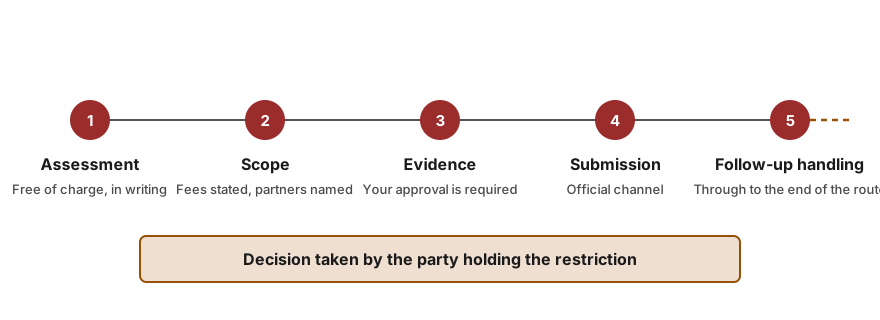
- Free initial assessment
You provide the request together with a brief description of how the funds were obtained. We state in writing whether a pack is realistic and which records you need to gather.
- Scope and fee in writing
In the procedure, you will receive a detailed written notice outlining the scope and the stipulated fee basis before any payments are rendered.
- Gathering
You submit your documents through a secure channel. We record what is present, what is absent, and which alternative records may serve as substitutes.
- Preparation and review
The pack and the narrative are assembled, then reviewed with you line by line so that gaps and inconsistencies are corrected before anything is sent.
- Filing and follow-up
The pack is sent by you through the official channel of the exchange, bank or processor. We assist with follow-up questions and state plainly when more documentation is required.
What to prepare
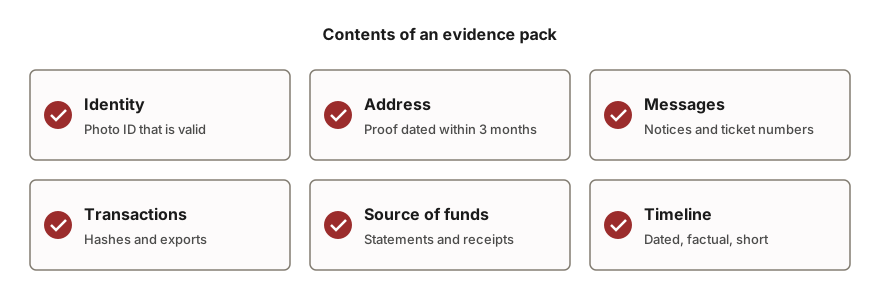
- Government-issued photo identification together with proof of address
- Bank statements that document the purchase or the transfers received
- Payslips, tax filings or invoices demonstrating the income from which the funds originate
- Exports of exchange accounts and trade histories, including closed accounts where these can be obtained
- Mining statements, payouts from pools, and receipts for hardware purchases
- Contracts of sale, deeds, or receipts covering assets that were disposed of
- Gift letters or inheritance papers showing the donor's details
- Wallet addresses under your control, together with a short timeline in writing
What our work involves
- Establish what the reviewer requires
Our team reviews the request and distinguishes source of funds, which concerns the particular deposit, from source of wealth, which concerns your assets as a whole. Replying to the wrong question is, in practice, a frequent cause of a second request.
- Trace the source of every sum
The formal procedure requires us to document the origin of funds, establishing whether they arose from income, a sale, or a similar transaction. We then demonstrate the complete movement of those assets across accounts until they arrived at the specific account currently under review.
- Match each claim to a record
Every statement in your explanation is paired with a supporting document: a payslip, bank statement, sale contract, exchange export, wallet history or gift letter. Where no record exists, we search for an acceptable alternative.
- Draft the narrative
We prepare a concise written account in plain wording. It traces the funds chronologically, cites every document by its name, and omits any statement the records cannot substantiate.
- Check consistency before submission
The procedure requires comparing all listed dates, monetary amounts, personal names, and addresses within the provided pack. Discrepancies frequently constitute the basis for rejecting a submission, so our intake service identifies these inconsistencies prior to the review by the relevant authority.
What falls outside our role
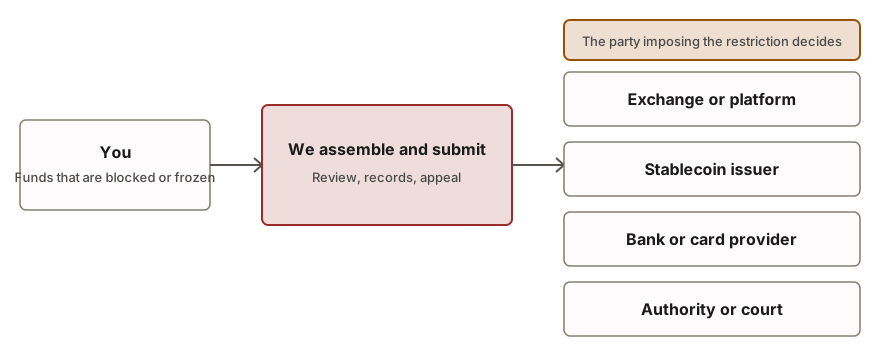
- No exchange, bank or processor is obliged to accept a pack. The reviewer decides, under its own rules and the law that governs it.
- We do not promise any result or any timeline.
- No document will be created, altered or backdated by us, and we will not assist in concealing the true origin of funds. Where the evidence does not exist, we state that plainly.
- Your seed phrase, private keys and passwords are never requested by us.
Expected timeframes
Collecting records is, as a rule, the slowest stage, in particular when the records sit with old exchanges or in other countries. After the assessment we give an estimate in writing and identify early which records are likely to take longer to obtain.
Fees
The assessment carries no fee. Once it is complete, you receive a written scope and a fee model. No fee is requested before we have told you whether we can assist. Fees →
Frequently raised questions
How does source of funds differ from source of wealth?
Source of funds sets out where the money in one specific transaction or deposit came from. Source of wealth explains how your overall assets were built up over time. A reviewer may request either one or both, and the two accounts must be consistent with each other.
What can be done if crypto was purchased years ago and no receipts exist?
People who bought cryptocurrency in early years frequently face this question. Acceptable substitutes include bank statements showing the payment, archived emails or export files from an exchange, blockchain wallet records, and a written explanation prepared with care. Our role is to identify which records actually exist and to state plainly which parts cannot be documented.
Does income from mining qualify as a valid source?
In most cases it does, provided documentation is available. Reviewers generally expect pool payout statements, wallet transaction records, receipts for hardware purchases and, where the jurisdiction requires it, reported income. What matters is a traceable connection between mining rewards and the specific funds under review.
Can a gift or an inheritance serve as a source of funds?
It can, when supporting documents are supplied. In the case of a gift, reviewers as a rule ask for a signed letter, identification of the donor and evidence of how the donor obtained the funds. For an inheritance, legal documents confirming the estate and the transfer are required.
If the account of my funds conflicts with what my paperwork shows, what then?
As a rule, the pack is rejected and any later review tends to become more demanding. For this reason we check every date and amount against each other before a submission is made. When a detail is inaccurate, the narrative is corrected, and the underlying document is never altered.
Can I assemble a pack before anyone requests one?
You can, and it is often sensible to do so before transferring a large sum or opening a new account. Having a pack ready can shorten the response period considerably when a request arrives. It can also be revised periodically as your activity changes.
Common situations
- Long-term holder who purchased crypto years ago on platforms that have since closed
- Miner whose earnings come from hardware, mining pools and several wallets
- Frequent trader with a record covering multiple exchanges and jurisdictions
- Worker or contractor remunerated in crypto, or whose wages were used to buy it
- Inheritance or gift taken in crypto, or in cash later converted
- Funds raised by selling a vehicle, real estate, shares in a company or other assets
- Several origins that have to be presented as a single coherent account
Related situations
- Unblocking an exchange account. Understand the restriction, prepare KYC and AML evidence, reply and appeal.
- Blocks on crypto cards and payment accounts. Card, neobank or processor account blocked: identify the trigger, document it, appeal.
- Sanctions and AML false positive help. If a sanctions or AML flag is a false match, we prepare your evidence and a lawyer files the statement.
- Diagnosing who froze your crypto. Establish who froze your funds and which next step is realistic.
Read next
The content on this page is general in nature and is not legal advice.