
Sanctions and AML false positives: how a wrong match happens
Published: Last reviewed: Editorial standards
A sanctions or AML false positive is an alert that connects you, or your wallet, incorrectly to a sanctioned person or a risky source. The cause is usually a name that closely matches, a shared date of birth, or an address that touched a flagged service. A reviewer checks your identity data against the listed entry, and if the two differ you can request that the match be cleared. Our service does not assist anyone in evading genuine sanctions.
Any question on your case may be put to us here:
What a false positive really means
Banks, exchanges and card providers use software that checks customers and transactions against sanctions lists and risk rules. The software is set to raise an alert rather than let a real match pass, because a missed match is costly for the company.
A human reviewer clears most alerts in practice. A false positive is an alert that proves unrelated to you. Your account can remain restricted during the review, which is why it feels like an accusation even though it is a routine step.
Why an exchange may flag the wrong name or address
Several routine circumstances result in incorrect database matches. These occurrences happen frequently and do not relate to your personal status.
- A name that matches or nearly matches: shared common names and different spellings of the same name across writing systems can trigger a match with a listed individual.
- Overlapping details: a matching birth year, a shared nationality or the same city of record can lift the score even where the individual is clearly different.
- Transliteration issues: the same name rendered in several spellings can produce duplicate records or close matches in screening systems.
- Address exposure: your wallet received funds from an address that analytics providers associate with a sanctioned or high-risk service, even though you had no knowledge of that origin.
- Outdated records: a list entry or cluster label that has since changed, while the screening tool continues to display the earlier result.
Telling a false positive apart from a true match
In principle, the test is straightforward. Set the listed entry beside your identity data: full name, date and place of birth, nationality, and any identifiers. Where several of these do not agree, the match is weak.
For addresses the question takes a different form. Did your funds in fact move from or to the flagged service, and how many steps separated the two? A direct connection is a harder problem to answer than one sitting four or five hops away.
Be candid with yourself about the underlying facts. If you are in reality the listed person, or you dealt knowingly with a sanctioned party, this guide does not apply to you, and no one can lawfully assist you in working around it.
How to contest a flag
A challenge works most effectively when it stays brief, factual, and anchored to your evidence. The reviewer is working through a checklist, not weighing your frustration with the delay.
- Request, in writing, that the company identify which check triggered the alert and specify what documents it requires from you.
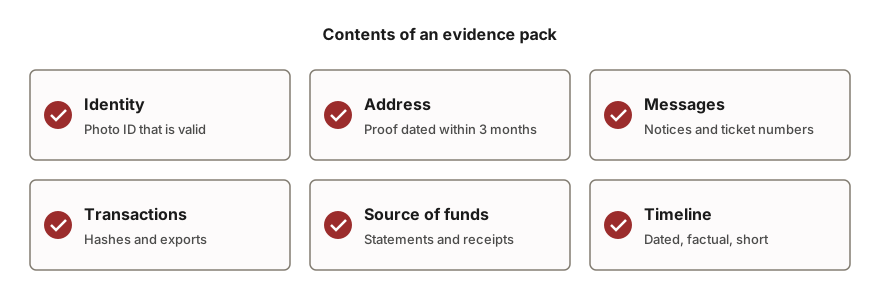
- Submit a legible copy of your identity document, and where applicable, proof of your address and place of birth.
- State briefly, in a few sentences, why your details do not match the listed entry, and attach supporting proof.
- Where a wallet has been flagged, provide a transaction history together with documentation showing the source of the funds.
- Record the ticket reference, and submit every document through the official channel only.
Our role and its limits
Our role is to assist people who have been wrongly matched, by organising their evidence and drafting a clear challenge. Independent specialists examine the transaction trail, and where the situation requires it, independent licensed lawyers advise on the legal route.
We do not assist anyone in evading genuine sanctions, concealing a true match, or moving funds around a restriction. We also have no power to compel a company to remove a flag, and we never request your seed phrase, private keys or passwords.
Frequently asked questions
If a sanctions alert is raised against me, does that mean I appear on a sanctions list?
No. An alert only indicates that the software detected a possible similarity. A reviewer then examines the record. In practice, many alerts are cleared after the company verifies in writing that your name, date of birth and other data do not correspond to the listed entry.
What is the usual duration of a sanctions review?
The duration depends on the company and on how complex the match is. In practice, simple name matches may be cleared promptly once documents are submitted. Cases involving an address history or a regulator request can take considerably longer.
May I withdraw funds while the alert remains open?
As a rule, no. Companies tend to hold withdrawals until the review procedure is finished. Ask the company in writing what options exist, for example returning the funds to their original source, and do not attempt to move them elsewhere in the meantime.
Is it possible for you to have me removed from a sanctions list?
No. Our service cannot remove any person or entity from an official list. What we do is help you prepare a written submission showing a company that a screening match does not concern you. Taking a name off an official list follows a separate legal procedure, and for that you need a licensed lawyer in the relevant jurisdiction.
How we can help
- Sanctions and AML false positive help. If a sanctions or AML flag is a false match, we prepare your evidence and a lawyer files the statement.
- Source of funds and wealth documentation packs. Build a clear source of funds and source of wealth pack for exchanges, banks and processors.
- Disputing risk flags from wallet screening. High-risk address flag from screening tools: record the funds path and dispute it.
- Diagnosing who froze your crypto. Establish who froze your funds and which next step is realistic.
The content on this page is general in nature and is not legal advice.