
P2P trade and a frozen account: bank holds, exchange blocks and records you should keep
Published: Last reviewed: Editorial standards
As a rule, funds are frozen after a P2P trade when the counterparty has been reported for fraud, or when the bank or exchange treats the payment as connected to a risky account. You may have acted correctly and still be affected. The procedure for release is to demonstrate that the trade was genuine: chat records, receipts, payment proof and your own transaction history. We help assemble that record and the submissions.
Any question on your case may be put to us here:
Who this service is meant for
- Your bank account was frozen after funds arrived from a P2P crypto buyer
- Your exchange account was restricted after you purchased crypto through P2P from a seller who was later reported
- A bank or a police officer informed you that the incoming payment is connected to a fraud complaint
- You accepted a crypto sale in good faith, and the buyer's bank has now requested that the payment be reversed
- You are unsure how to demonstrate that the trade was genuine and the payment was fair
The procedure for a case
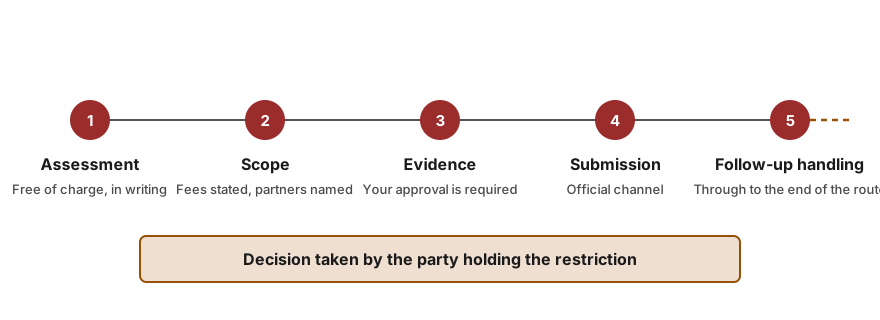
- Free initial assessment
You describe what was frozen, which party imposed it, and how the transaction proceeded. We state in writing whether our assistance is possible and which route appears likely.
- Scope and fee in writing
If the case proceeds, you receive the scope of work, the fee model and the names of the independent specialists involved in writing before any payment is due.
- Gather the evidence
You transmit the chat logs, receipts, bank statements and platform records through a secure channel. We review the submission for gaps and contradictions before any document is forwarded.
- Formal Review
Appeals are filed through the official channels of the bank and the exchange. You are provided with copies of each submission along with the reference numbers.
- Follow-up handling
Replies from the counterparties are tracked, assistance is given with follow-up questions, and you are told plainly once the case has reached the end of what can be done.
What to prepare
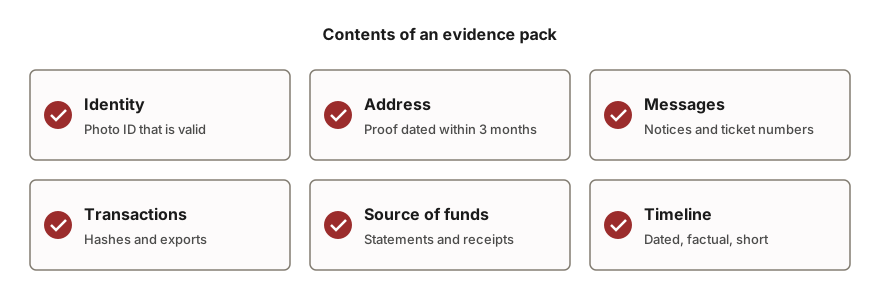
- Government-issued photo identification together with proof of address
- Screenshots or an export of the P2P advertisement and the complete chat with the counterparty
- Payment confirmation from your bank or payment application, showing the date and the amount
- The order record of the P2P platform together with the release confirmation
- Exchange history demonstrating the coins that were received or sent
- The notice issued by the bank or the exchange, including its reference number
- Your prior P2P or trading record indicating regular, ordinary activity
- A brief written chronology of the trade in question
What our work involves
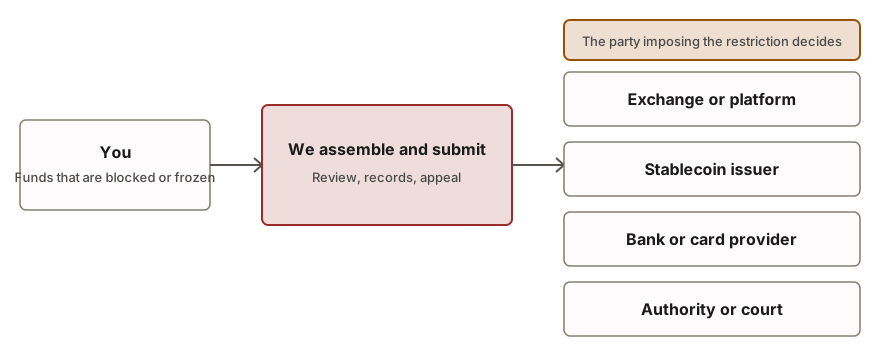
- Identify the party that froze the funds and the reason
A bank freeze, an exchange freeze and a police hold follow different procedures and offer different exits. In practice, our role is to read each notice, determine which party holds the funds, and record the type of request involved.
- Rebuild the trade record
The procedure for a P2P transaction involves several elements: the initial advert, subsequent dialogue, determination of terms, proof of payment, and the final release of the digital assets. A chronological compilation of these recorded events serves as substantial evidence of the trade's execution.
- Demonstrate that you acted in good faith
Our role is to help you assemble evidence of ordinary trading conduct: prices set at market rate, your completed identity checks, records produced by the platform itself, and your prior dealings. When one transaction is read alongside a consistent history, it presents quite differently.
- Prepare written appeals for the bank and the exchange
For each recipient, we prepare a brief written appeal that cites the reference number, includes the supporting documents and states a defined request, for example release of the funds or written confirmation of what further documents are required.
- Engage independent counsel when required
Should the bank or the authority fail to give a response, or should the sum involved warrant it, independent licensed lawyers may pursue formal legal steps. We assemble the submission file and manage coordination across the parties.
What falls outside our role
- No bank, exchange or police force can be compelled by us to release funds. Each party decides under its own procedures and the law that governs it.
- We cannot promise any outcome or any date. Where a payment is frozen because of a fraud matter, the hold may remain in place for a long period.
- Altering documents, creating false evidence, or concealing a genuine connection to fraud is not something we will take part in.
- Your seed phrase, private keys and passwords are never requested by us.
Expected timeframes
As a rule, reviews by a bank or the exchange run for weeks, and where a hold is connected to a police inquiry the period can extend beyond that. Once the assessment is complete we provide an estimate, and as the case progresses we revise it in writing.
Fees
The assessment carries no fee. After it, you receive a written scope and fee model suited to your case type. No fee is requested before we have told you whether assistance is possible. Fees →
Frequently raised questions
Why did the freeze affect my funds when the transaction was an ordinary P2P trade?
In practice, banks and the exchange screen the accounts connected to each payment. Where the counterparty has been reported for fraud, or where their account is itself under review, your payment can fall under the same hold even though you acted in good faith. After that, the burden falls on you to demonstrate that the trade was genuine.
What evidence carries the most weight in proving the trade was genuine?
A complete dated sequence carries the most weight: the advert, the full chat record, the price agreed, the payment proof and the release of the coins. Include the order record from the platform and your own trading history as well. Gaps or edits in the chat logs weaken the submission.
Is it possible for the other party's bank to reclaim the funds?
This depends on the jurisdiction and the terms you accepted. As a rule, a bank can recall or reverse a payment where the sender states it was sent in error or through fraud. Your response should set out the trade evidence. Where a substantial sum is claimed back, a licensed lawyer may need to act for you.
Is it permissible for you to attempt the transfer of funds or assets to an external platform?
Moving holdings that are currently under review may appear as an attempt at concealment and could complicate the appeal process. Maintaining the existing account status, responding to all inquiries, and documenting all communications are required actions.
Bank freeze versus exchange freeze: how do they differ?
A freeze initiated by a bank retains your fiat currency typically following a fraud report, a court directive, or internal risk mandates. An exchange freeze pertains to your crypto assets, usually resulting from a compliance assessment, and both procedures may be active.
Will consulting a licensed attorney be necessary for this situation?
In practice, legal consultation is generally not required at the initial stage of this process. Legal expertise is relevant should the authority disregard the appeal, initiate a recall claim, or if the disputed amount is substantial. Independent licensed professionals manage the necessary legal steps, and the need for such counsel will be indicated when that threshold is approached.
Common situations
- A freeze placed by the bank on the account that received payment through a P2P trade
- Coins frozen by the exchange after a purchase from a counterparty flagged as a scammer
- A chargeback or recall filed by the counterparty's bank after the trade had already been completed
- The counterparty asserts the transfer was sent in error or under duress
- A high number of small P2P trades within a short period reported as unusual activity
- Restriction of funds may occur while a police inquiry concerns the account held by another party.
Related situations
- Unblocking an exchange account. Understand the restriction, prepare KYC and AML evidence, reply and appeal.
- Source of funds and wealth documentation packs. Build a clear source of funds and source of wealth pack for exchanges, banks and processors.
- When authorities freeze your cryptocurrency. When authorities hold your assets, we arrange independent licensed lawyers. This is not legal advice.
- Blocks on crypto cards and payment accounts. Card, neobank or processor account blocked: identify the trigger, document it, appeal.
Read next
Sources
Authoritative and official pages on which this page relies. Such pages are updated, so confirm the current wording at the source itself.
The content on this page is general in nature and is not legal advice.