
Determining the Duration of an Exchange Compliance Review: Factors Affect Process Timeline
Published: Last reviewed: Editorial standards
An exchange cannot stipulate a single standard duration since the timeline depends on review reasons, answer completeness, and operational volume. Kraken documentation indicates reviews typically require 10 to 14 business days. Coinbase states resolution for restrictions takes up to 10 business days, although certain cases may exceed this. Other platform documentation provides no general review timeframe.
Any question on your case may be put to us here:
Examination of Official Exchange Documentation Regarding Timelines
Numerous exchanges do not publish a specific deadline for a compliance review, and none can make such a commitment. Only two assistance pages provide preliminary timeframes. These are the sole time figures presented on this page. Examine them to determine typical duration, then consult your specific exchange page frequently because support documentation is subject to change.
The Coinbase duration originates from a resource addressing restrictions linked to suspected malicious activity, which is one security concern. This specific documentation may not cover all types of compliance reviews. Conversely, the Kraken resource addresses a broader spectrum of temporary restrictions, encompassing regulatory and legal mandates. Both sources maintain that some specific instances may extend past the stated duration.
Other platform support documentation reviewed by this service does not supply a general review timeframe. Certain resources state a duration for only one narrow step, such as a specific appeal, which does not apply to a complete compliance review. Document the specific date your restriction commenced to accurately track when the quoted range may have elapsed.
| The Exchange | Stated Duration for Review | Scope of Review Details |
|---|---|---|
| Kraken | Generally, a review requires between 10 and 14 business days, although delays occur during periods of high volume. | Temporary limitations may arise from matters such as non-standard activity, identification data requiring updates, a transaction reversal, or specific legal mandates. |
| Coinbase | The process for resolving restrictions generally requires up to 10 business days, though specific instances may require additional time. | Restrictions related to account security are documented on the page, and Coinbase states that a notice is provided via email upon conclusion of the review. |
| Diverse Platforms | The pages we checked do not publish a standard review period. | A small number of exchanges set a deadline for only one limited step, for example a single type of appeal. |
Factors that determine the length of your compliance review
The wait time for different accounts undergoing review varies significantly. Some causes for delay are beyond your control, while others require action on your part.
- The ground for the review. Refreshing an identity check is, as a rule, a simpler matter than explaining the source of a large deposit.
- The completeness of your formal submission is essential for processing; missing pages, unreadable scans, or skipped questions may result in the return of your file, which Kraken states can add days to the timeline.
- Whether your records match one another. Differences in names, dates or amounts across documents usually prompt new questions from the reviewer.
- Workload on the team. Kraken's help page states that a review may take longer during busy periods.
- Whether a third party is part of the matter. Where a court order or a request from an authority stands behind the restriction, the exchange may need to await action from that body.
- How much of the history needs explaining. A brief, clean record takes less time for the exchange to examine than years of transactions spread across many wallets and platforms.
The steps of a review and who is waiting on whom
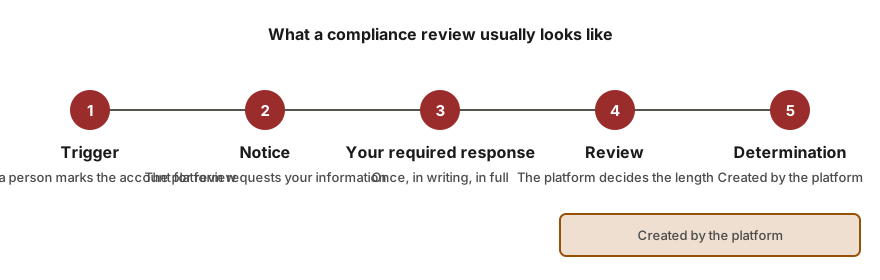
Each exchange labels its procedure in its own way, so read this as a broad pattern rather than the workflow of any single platform. As a rule, reviews move through similar steps. In practice, the longest delays tend to fall at the points where the exchange is waiting for a response from you.
Use the table to work out where your matter likely sits at this moment. When the stage is yours, act first. When the stage belongs to the exchange, allow the stated period to pass before you send a follow-up.
| Stage | What commonly occurs | Which party waits | What remains open to you |
|---|---|---|---|
| Formal Notice Received | The account is restricted. A notice or on-screen banner sets out the reason in broad wording, or names a category only. | You are waiting for a clearer explanation | Read the notice carefully, record the deadline and the required channel, and store a copy for your file. |
| Information request | The exchange requests identity papers, proof of address, or evidence showing the origin of the funds. | You are the party the exchange is waiting on | Submit one complete reply through the channel stated in the notice, and retain the reference number. |
| Review of documents | A reviewer, or an automated check, compares your submission against the records held on the account. | The exchange is the party you are waiting on | Allow the stated period to pass, and refrain from new transfers that create further activity to explain. |
| Additional questions | The reviewer can request a missing page, a sharper scan or a brief written explanation. | You are the party the exchange is waiting on | Reply to precisely what was requested, within the same thread, at the earliest moment you can. |
| Determination | The measure is removed, reduced or kept, or else the account is shut. | The exchange is the party you are waiting on | Study the decision. Should the restriction remain, request the particulars that are still outstanding. |
| Appeal or escalation stage | A second review is available at certain exchanges. Others publish no appeal procedure. | Determined by the exchange in question | Follow the route set out in the notice, and obtain the precise reason before you submit anything further. |
Why a review takes longer than expected
Most holdups trace back to the same handful of errors. Kraken's help page instructs customers to respond to every question at once, with documents that are clear and current, and it cautions that incomplete replies can cost extra days. That guidance applies on any exchange. Compare your own submission with the list below before you send it.
- Submitting documents in parts across several days, so the reviewer never holds one complete file.
- Scans that are cropped, blurry or expired, or a name that does not match across documents.
- Replying to a question the exchange never asked, while leaving its actual question unanswered.
- Filing multiple tickets about the same matter, which can spread responses across separate threads.
- Transferring funds while the review is open, which creates fresh activity that must then be explained.
- Hostile or threatening messages. These add pages to the file without adding any facts.
- A legal order behind the restriction. The exchange may not be able to close the matter until the authority acts.
What to do during the waiting period
The wait does not need to be idle. A brief routine keeps your record orderly and prepared for the next submission.
- Record the date the restriction started, the date of your response and the reference number you were given.
- Review your email, the spam folder and the exchange's app for fresh requests. Kraken's help page states it sends an email and an in-app notice when more is needed, and that many reviews conclude without any request.
- Preserve each message you received and each file you submitted, together with their dates.
- Do not transfer funds or create another account to bypass the review. Should the exchange permit a withdrawal, comply with its own instructions.
- If another person may have accessed your account, follow the exchange's security procedure. Kraken's page lists a password reset, removal of unknown devices and verification of two-factor authentication.
- Once the stated range has elapsed, follow up once within the same thread. Cite your reference number and pose one specific question. Kraken's page proposes chat support if more than 14 business days pass in silence.
- Disregard anyone who contacts you first and offers, for a fee, to accelerate the review. Never provide a seed phrase, private key or password to any person.
When patience alone stops being enough
Certain signs indicate the case requires more than waiting. The stated range has ended without a response. The same documents are requested repeatedly. The notice refers to a legal request. A substantial amount is at stake.
Where that happens, ask the exchange in writing, within the same thread, which document or detail remains outstanding. If the exchange holds a licence, a complaint to its regulator or ombudsman may be available in jurisdictions that provide such a route. A specialist can also review your file for gaps and prepare a clear written response.
That check takes place at the free assessment stage. Before any fee arises, we state in writing whether our assistance is possible. We cannot accelerate the exchange or decide on its behalf, and we never ask for a seed phrase, private key or password. If your review has exceeded the stated range, request the free assessment.
Frequently asked questions
Can an exchange compliance review be accelerated?
Not directly. The exchange controls its own timetable, and no outside party can compel a decision. What remains in your hands is the quality of your submission: one complete package, documents that match each other, and the channel the exchange named. Those steps address the delays that occur most often.
What happens if the review exceeds the timeframe on the help page?
Support pages outline ordinary cases, and the two pages we reviewed also permit longer timelines. Once the published range has elapsed, send one follow-up in that same thread, cite your reference number, and request a list of anything still outstanding. Retain each response you receive.
If the review is taking a while, does that mean the exchange thinks I have done something criminal?
As a rule, no. A lengthy review often means the exchange is awaiting a document, a second check, or input from an outside body. A request issued by a court or an authority is a separate matter, and the notice ordinarily states this.
Does every exchange publish the duration of its review?
No. Among the help pages we read for this site, only those of Kraken and Coinbase gave a general range. The others list steps without stating a time, or provide a time for one narrow process only. Consult your own exchange's current page for the latest wording.
If the exchange stays silent, should I submit my documents a second time?
As a rule, wait for the exchange to request them. A duplicate submission can split your case across two threads. Respond in the original thread, cite your reference number, and ask in writing whether the documents were received and whether anything further is needed.
How we can help
- Unblocking an exchange account. Understand the restriction, prepare KYC and AML evidence, reply and appeal.
- Diagnosing who froze your crypto. Establish who froze your funds and which next step is realistic.
- Source of funds and wealth documentation packs. Build a clear source of funds and source of wealth pack for exchanges, banks and processors.
- Filing complaints with a regulator or an ombudsman. Draft a structured complaint to the regulator, ombudsman or consumer body, with a clear chronology.
Sources
Authoritative and official pages on which this page relies. Such pages are updated, so confirm the current wording at the source itself.
- Why is my account restricted? · Kraken
- Resolve your account restriction · Coinbase
The content on this page is general in nature and is not legal advice.